
From Curious to Confident: Arjun's Olympiad Journey
By The Sophoz Curriculum Team
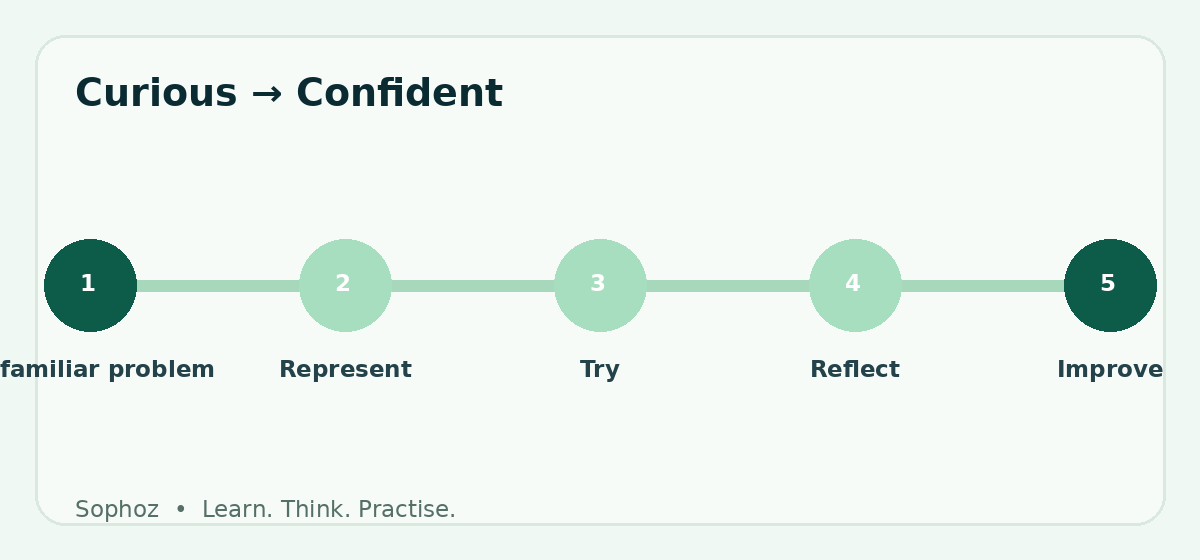
The goal is not more worksheets. It is stronger understanding, better decisions and more independent problem solving.
Arjun liked maths—until it stopped looking familiar
Arjun is a fictional Class 6 learner, created to illustrate a common preparation journey. At school, mathematics usually felt comfortable. He understood examples quickly, completed homework and liked getting answers right.
Then he opened an Olympiad practice set. The numbers were familiar, but the questions were not. Some looked like stories. Some contained diagrams. Some seemed to require two ideas at once. Arjun's first reaction was that he had somehow become 'bad at maths' overnight.
The real problem was not knowledge
When his practice was reviewed, many mistakes were not caused by missing concepts. Arjun knew factors, fractions and basic geometry. He was often beginning a calculation before he had decided what the problem was asking.
That distinction changed the plan. Instead of adding more chapters, he began practising how to read, represent and choose a strategy.
A new routine for difficult questions
For every unfamiliar problem, Arjun used four prompts: What do I know? What do I need to find? Can I draw or organise the information? What is one approach I can try?
At first, writing these steps felt slow. But the routine prevented him from jumping at the first visible number. A table helped with patterns. A sketch helped with geometry. Listing small cases helped with counting problems.
The error log that changed his practice
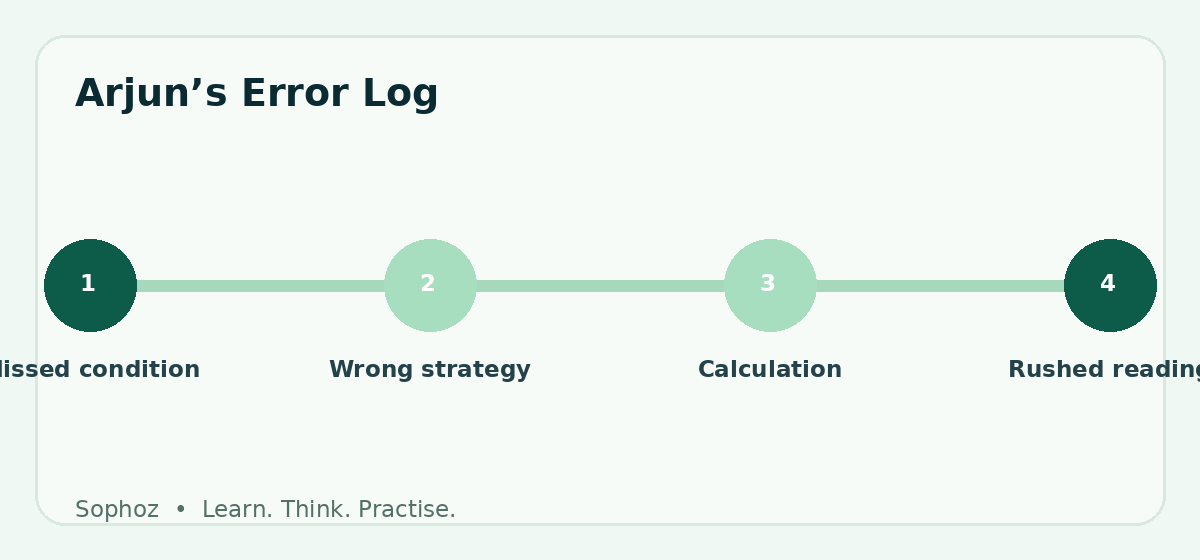
Arjun kept a small error log rather than copying complete solutions. He wrote a short label for each important mistake: missed condition, wrong strategy, calculation, rushed reading or concept gap.
After two weeks, a pattern appeared. He frequently missed words such as 'exactly' and 'different'. He also tried to do too much arithmetic mentally. Those were concrete habits he could change.
Practice became mixed
Early worksheets had been organised by chapter. Arjun always knew whether he was doing fractions or factors. His new sets mixed topics. Now he had to recognise the structure before selecting a method.
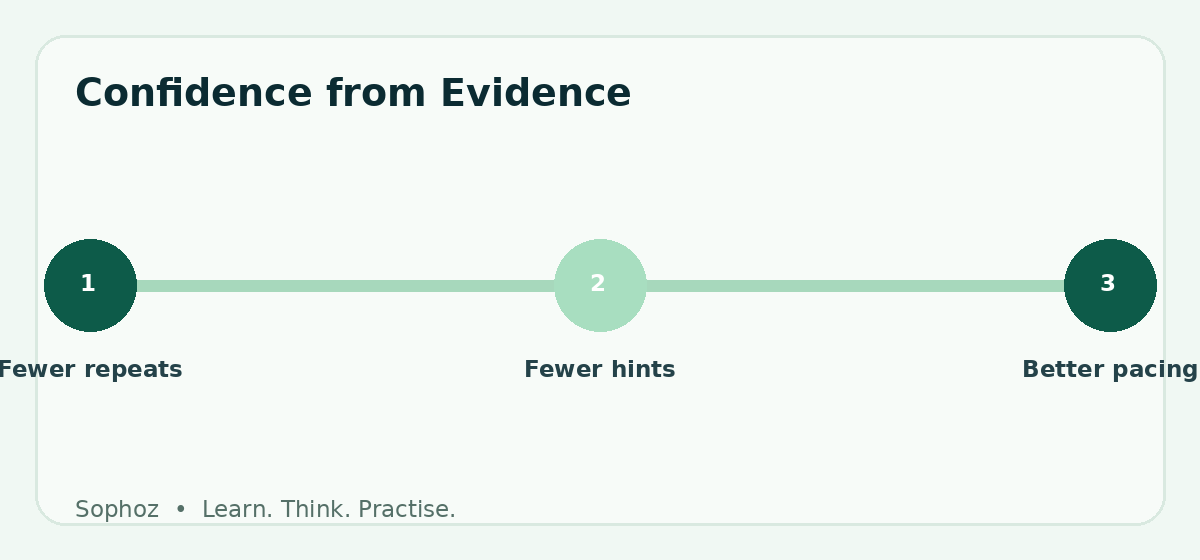
His scores initially moved only a little. Yet something more important changed: he asked for fewer hints. He became willing to sit with a question for longer and test an idea.
Timing came later
Only after his accuracy improved did Arjun begin timed mini-tests. He learned that speed did not mean solving everything immediately. It meant making good decisions: solve the clear questions, mark a stubborn one, return later and protect enough time to check.
That reduced the feeling that every difficult question was an emergency.
Confidence became evidence-based
A few weeks earlier, confidence meant hoping that the paper would contain familiar questions. Now Arjun could point to evidence. He had fewer repeated errors. He could explain why a method worked. He recovered faster when his first approach failed.
That is a more durable form of confidence because it does not depend on every question being easy.
What parents can learn from Arjun
The story is fictional, and every learner is different. But the pattern is useful: diagnose before adding work, teach a problem-solving routine, review errors by cause, mix practice and introduce timing gradually.
Most importantly, avoid using a single practice score as a label. A learner can be developing valuable reasoning habits even before the score fully reflects them.
Curiosity is the starting point
Olympiads can be one place where a child discovers that mathematics is not only about remembering procedures. A strange question can become an invitation: what pattern is hiding here? What would happen if I tried a smaller case?
When preparation protects that curiosity, confidence has something meaningful to grow from.
A practical way to use this guidance at home
Choose one small change rather than rebuilding the entire routine in a day. For example, introduce a five-minute retrieval warm-up, begin an error log, or replace one chapter-labelled worksheet with a mixed set. Use the change consistently for two weeks and observe what happens.
Parents should look for behavioural evidence as well as scores. Does the learner begin work with less prompting? Do they explain ideas more clearly? Are the same mistakes recurring less often? Can they identify what they find difficult? These indicators help distinguish productive practice from mere activity.
Keep the environment simple. A clear desk, the required materials, a visible timer when timing is appropriate and a defined end point can reduce negotiation. Finish while the learner still has some energy rather than extending every session until attention disappears.
Questions parents can ask after practice
Useful questions keep the focus on learning: Which question required the most thinking? What clue helped you? Where did your first approach fail? Which mistake would you recognise faster next time? Can you explain one solution without looking at your notes?
Avoid turning reflection into interrogation. One or two questions are enough. The aim is to help the child notice their own thinking so that strategies gradually become self-directed.
Over time, invite the learner to choose part of the next session. They might select a weak topic to revisit or a problem they want to retry. Small choices can increase ownership without removing structure.
What success should mean
A competition naturally produces scores and ranks, but preparation can be judged more broadly. A successful learner becomes more accurate, more strategic and more willing to engage with unfamiliar material. They recover from errors faster and need fewer external prompts.
Those capabilities are valuable even when a particular paper is unusually difficult. They also reduce the temptation to treat one result as a permanent label.
Use the exam as a checkpoint. After it, discuss what worked, what the learner would change and which kinds of problems they would still enjoy exploring. That turns a one-day event into useful information for future learning.
A final note for families
Preparation works best when it remains proportionate to the child's age and wider life. The purpose of structured practice is to make thinking clearer, not to fill every free hour. Keep expectations explicit, feedback specific and the routine predictable.
When a learner struggles, diagnose before increasing pressure. When a learner succeeds, ask what strategy contributed. In both cases, direct attention toward processes that can be repeated. That is how an exam-specific routine can contribute to a more general ability to learn independently.
Revisit the plan regularly. What was appropriate four weeks ago may no longer be the best use of time today. Strong learning plans are responsive: they preserve what is working, remove what is not and keep the next challenge within reach.
Sources and further reading
- SOF IMO Class 6 syllabus and pattern
- SOF IMO 2026–27 overview
- SOF Class 6 IMO preparation guide
- SOF Class 6 Science syllabus
- Education Endowment Foundation: cognitive science in practice
Exam details can change. Always verify the current syllabus, dates and pattern with the official organiser.