Products

Standalone skills for growing children

Build skills that compound beyond school.

Standalone programmes that sit alongside school rather than inside it. Chosen because they compound, not because they are examined.

The programmes

Three skills. Three different reasons to practise.

Each programme is deliberately focused on a skill that benefits from sustained practice. The point is not a certificate at the end. The skill is the point.

Vedic Maths

Mental calculation techniques that make arithmetic fast, practised to fluency, then measured honestly.

The goal is not speed for its own sake. It is to help children become more fluent with numbers and less dependent on slow, mechanical calculation.

Explore Vedic Maths →
Public Speaking

Structured practice at speaking to a room: preparation, delivery, and recovering when it goes wrong.

The programme treats confidence as something a child can practise. The work is concrete: prepare an idea, deliver it, respond, recover and try again.

Explore Public Speaking →

Olympiad Preparation

Problems that reward reasoning rather than recall, with preparation paced backwards from the exam date.

Olympiad preparation helps students become more comfortable with unfamiliar problems and deciding what to try when the answer is not immediately obvious.

Explore Olympiad Preparation →

Why programmes are different

No exam date. No certificate chase. Just a skill getting better.

A programme is something a parent chooses deliberately. No school term requires it, no report card records it, and nobody is examined on it next month.

That absence of a deadline changes what good practice looks like. Progress has to be visible in the skill itself.

“The skill is the point.”
Sophoz programmes

What good programme design looks like

Practice should make small gains visible.

A child rarely notices that they have become much better at a skill. They simply stop finding it difficult. That makes the reporting around practice especially important.

Deliberate practice

Sessions focus on the specific behaviour the child is trying to improve, not just activity for activity's sake.

Visible progress

Progress should be understandable to the parent paying for months of small gains.

Real skill building

Confidence comes from repeatedly doing the thing, not from collecting badges or certificates.

Long-term value

Programmes are chosen because the skill can compound beyond a single school term or assessment.

Programme 01

Vedic Maths

Mental calculation techniques that make arithmetic fast, practised to fluency, then measured honestly.

Make mental calculation feel lighter.

Vedic Maths is about developing alternative ways to work with numbers so calculations can become faster and more fluent.

The important part is the practice. Learning a shortcut once is not the same as being able to retrieve it quickly, apply it accurately and choose when it is useful.

  • Build mental calculation fluency
  • Practise techniques repeatedly
  • Track progress honestly over time
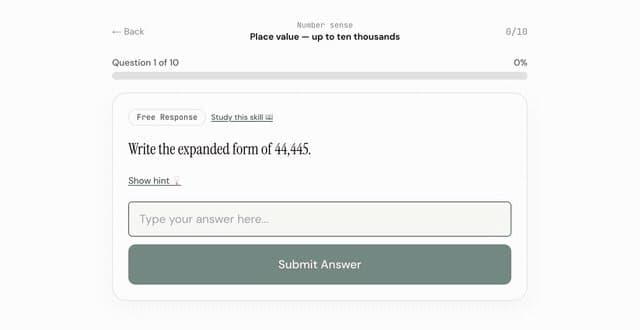
Sophoz quiz screen: a free-response question, “Write the expanded form of 44,445”, with an answer box and a Submit Answer button
Quiz screen
A question answered and checked

Programme 02

Public Speaking

Structured practice at speaking to a room: preparation, delivery, and recovering when it goes wrong.

Confidence is easier to build when it is practised.

A child who dreads being asked a question in class can learn, with repeated practice, to organise an idea, speak clearly, recover from a mistake and continue.

The programme treats public speaking as a learnable skill rather than a personality trait. Students practise the parts that make speaking work: preparation, delivery, pacing, clarity and recovery.

  • Prepare an idea before speaking
  • Practise delivery and clarity
  • Learn to recover when delivery goes wrong
Sophoz quiz screen: a free-response question, “Write the expanded form of 44,445”, with an answer box and a Submit Answer button
Quiz screen
A question answered and checked

Programme 03

Olympiad Preparation

Problems that reward reasoning rather than recall, covering Classes 1 to 12 and paced backwards from the exam date.

Who it suits

Children already comfortable with their year's school mathematics who want something that stretches their reasoning and problem-solving skills.

What it develops

The habit of approaching unfamiliar problems without freezing: trying a small case, drawing something, testing a pattern and deciding what to try next.

Learn the concept. See the method. Solve the problem.

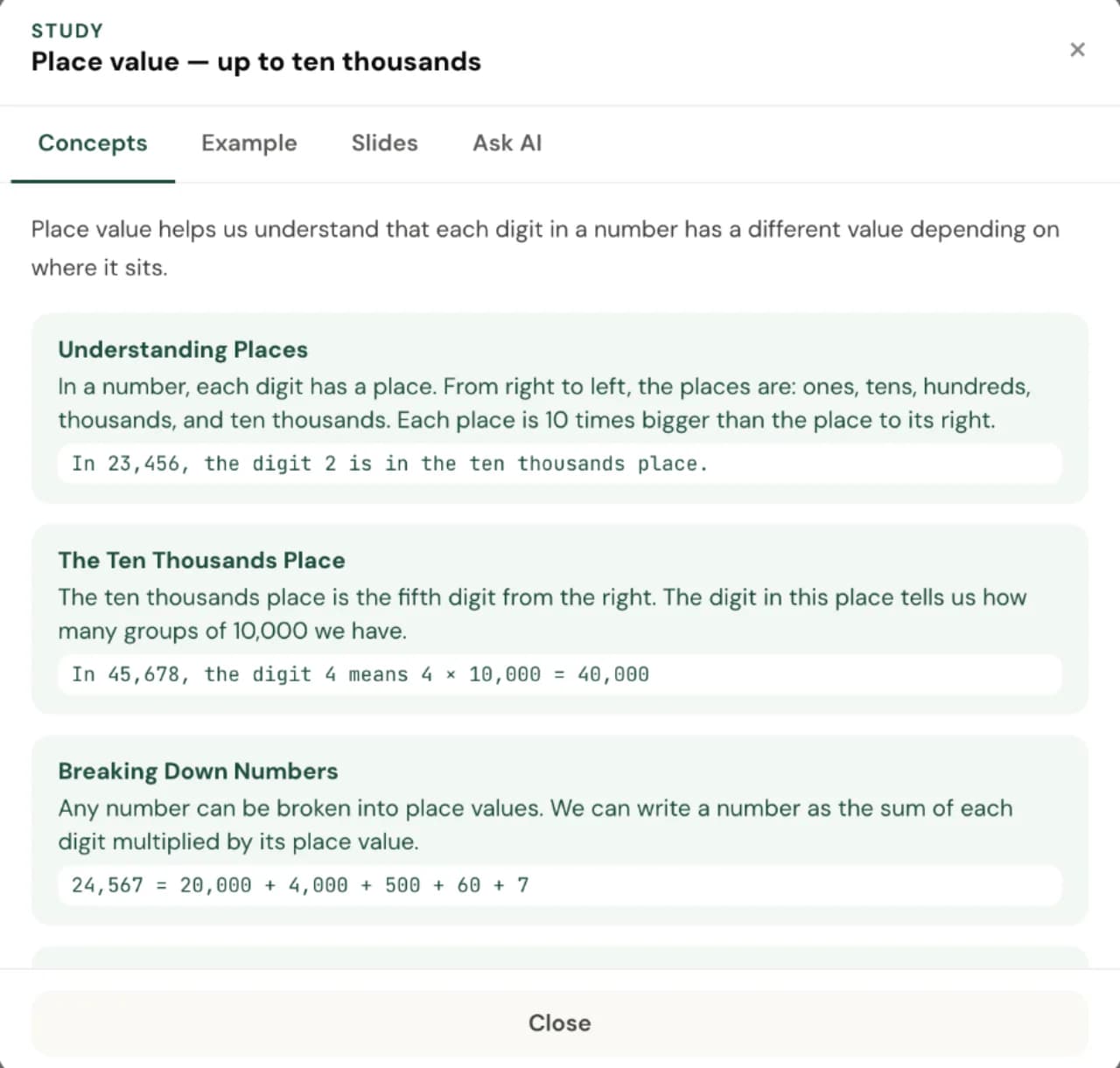
Sophoz combines concept explanations, worked examples, visual slides and AI-assisted support inside the learning experience.

That makes the journey more than question, answer and score. Students can understand the concept, see a method, examine common mistakes and return to the problem with another way in.

Sophoz Concepts view showing a structured place-value lesson
Concepts view

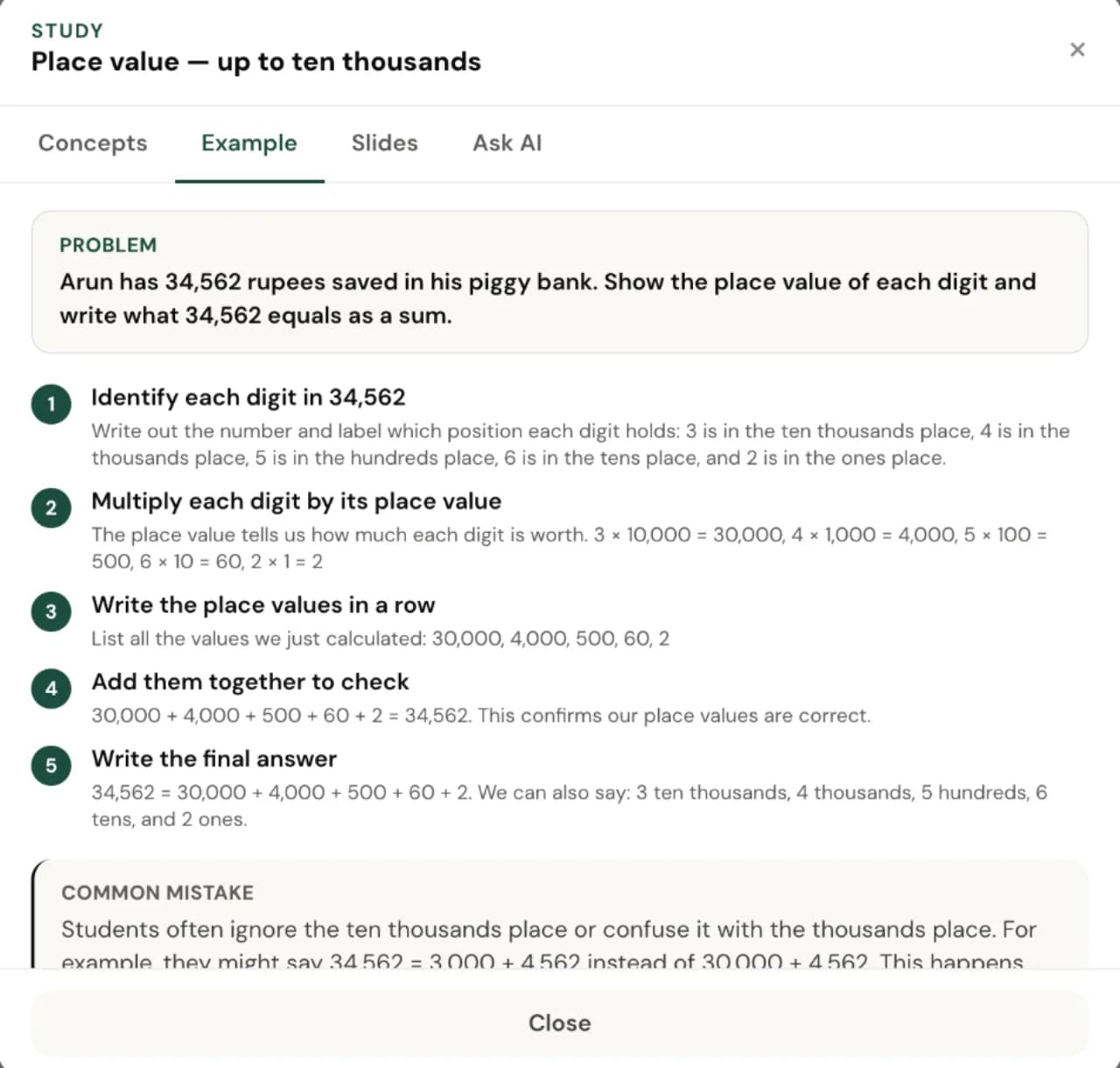
See how a solution is built.

The worked example breaks a problem into steps, showing how to identify the relevant information, work through the method and check the result.

The emphasis is on how to think through the problem, not only what answer appears at the end.

Sophoz Example view showing a step-by-step worked mathematics problem
Worked Example view

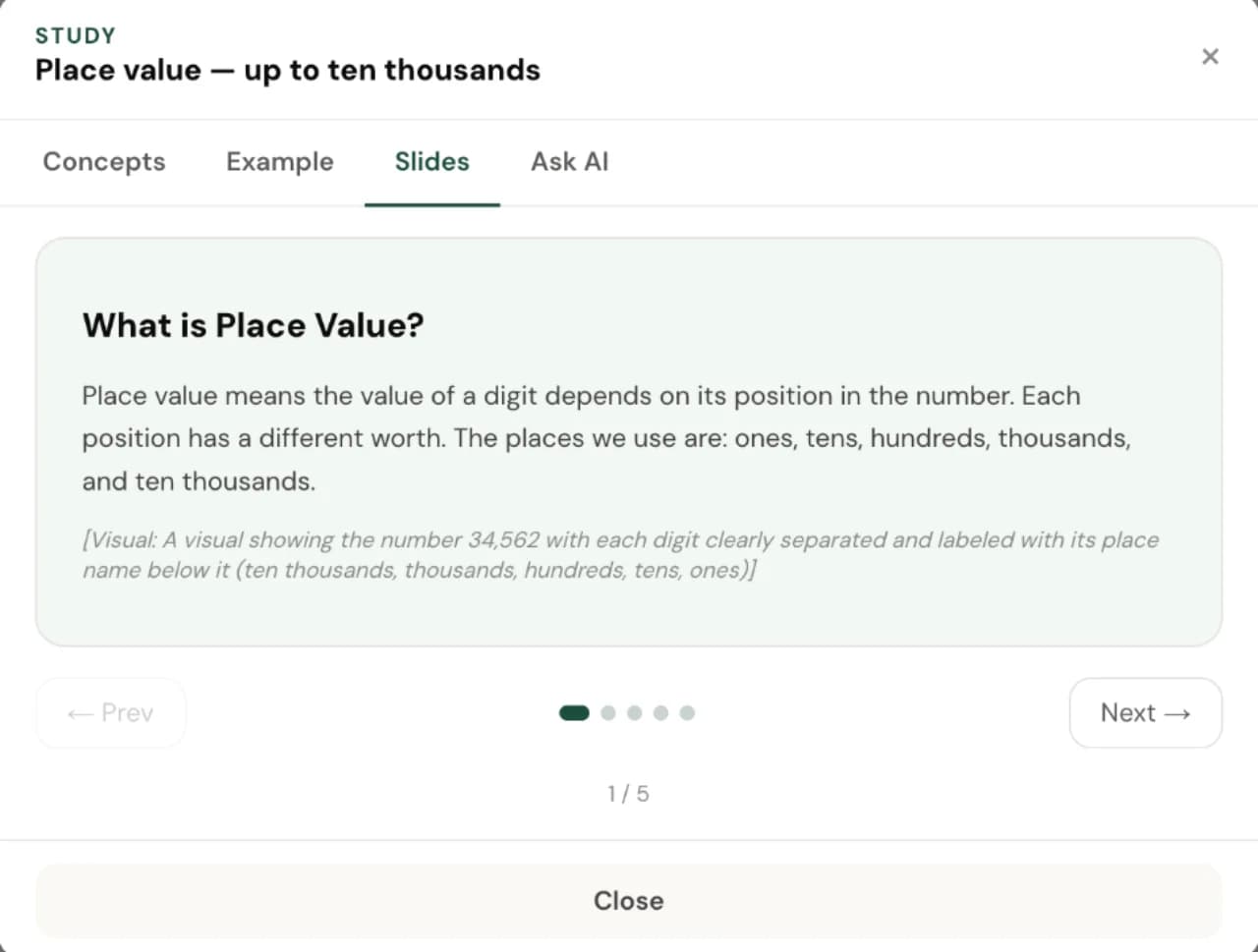
Revisit concepts visually.

The Slides experience gives students a simple sequence of visual explanations they can return to when a topic needs another pass.

Sophoz Slides view showing a visual explanation of place value
Slides view

Get another explanation when stuck.

The Ask AI pathway gives learners another way into a concept when they need a different explanation or want help getting started.

The goal is to support thinking, not remove the challenge.

Sophoz quiz screen: a free-response question, “Write the expanded form of 44,445”, with an answer box and a Submit Answer button
Quiz screen
A question answered and checked

How the programmes differ

Three different outcomes, one approach to practice.

Vedic Maths

The outcome is greater speed and fluency with mental calculation.

Public Speaking

The outcome is greater confidence and control when speaking to other people.

Olympiad Preparation

The outcome is greater comfort with unfamiliar mathematical problems and reasoning.

The common thread

In each programme, the skill is developed through repeated practice and made more visible through reporting.

Frequently asked questions

Questions parents ask about Sophoz programmes

What are Sophoz programmes?

Sophoz programmes are standalone skills programmes that sit alongside school. They focus on skills that can compound over time rather than skills tied to a specific school examination.

How are programmes different from school learning?

School learning is shaped by curriculum, term schedules and assessment. A programme is chosen deliberately to build a specific skill regardless of whether that skill appears on the next school report.

What programmes does Sophoz offer?

This page covers Vedic Maths, Public Speaking and Olympiad Preparation.

How do parents know whether a programme is working?

The useful measure is whether the child is visibly better at the underlying skill over time. Reporting helps make small gains easier for parents to see.

Is Vedic Maths about becoming faster at calculations?

Yes. The focus is on mental calculation techniques, repeated practice and building fluency while keeping accuracy visible.

Can public speaking confidence be taught?

Public speaking becomes easier to improve when the child repeatedly practises preparation, delivery, clarity and recovery rather than treating confidence as something they either have or do not have.

What classes does Olympiad preparation cover?

Sophoz Olympiad preparation covers Classes 1 through 12. There are IMO, ISO and IEO pages for every class, maths practice for every class, and science and English practice up to Class 10.

Who is Olympiad preparation best suited for?

It is best suited to children who are already comfortable with the mathematics of their year and want additional challenge through unfamiliar, reasoning-focused problems.

Choose a skill worth getting better at.

Explore the Sophoz programme that fits what your child needs next.