
School Olympiad Preparation
Olympiad preparation that teaches children how to think.
Preparation for school Olympiads — problems that reward reasoning rather than recall, paced backwards from the exam date.
- 01Reasoning, not recall
- 02Backward-paced preparation
- 03Classes 1–12
- 04Confidence with unfamiliar problems
Why Olympiads are different
Olympiad questions are different.
They are usually solvable with syllabus knowledge, but require the child to notice which piece of that knowledge applies. That is a distinct skill — and it is trainable.
A student may know the mathematics and still struggle with an unfamiliar problem because the first step is not obvious. Good Olympiad preparation makes that moment less intimidating.
“It’s not about knowing more. It’s about thinking differently.”
The Sophoz learning experience
Learn the concept. See the method. Solve the problem.
Sophoz brings concepts, worked examples, visual slides and AI-assisted support into the same learning experience.
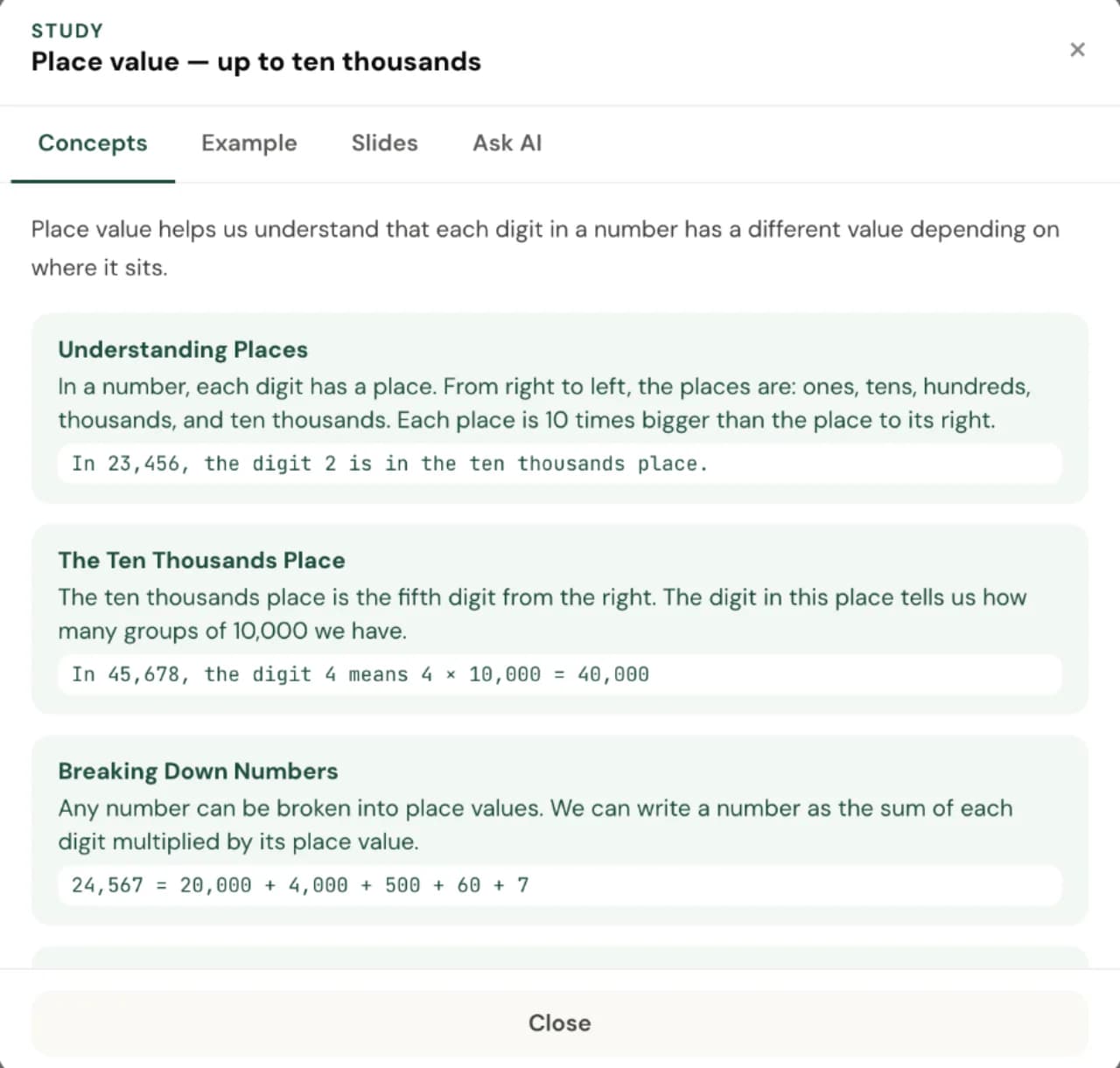
Understand the concept first
The Concepts view gives the student a clear explanation of the idea behind a topic before they return to practice.
This matters when an unfamiliar problem is difficult not because the student has never seen the mathematics, but because they need to see the underlying structure again.
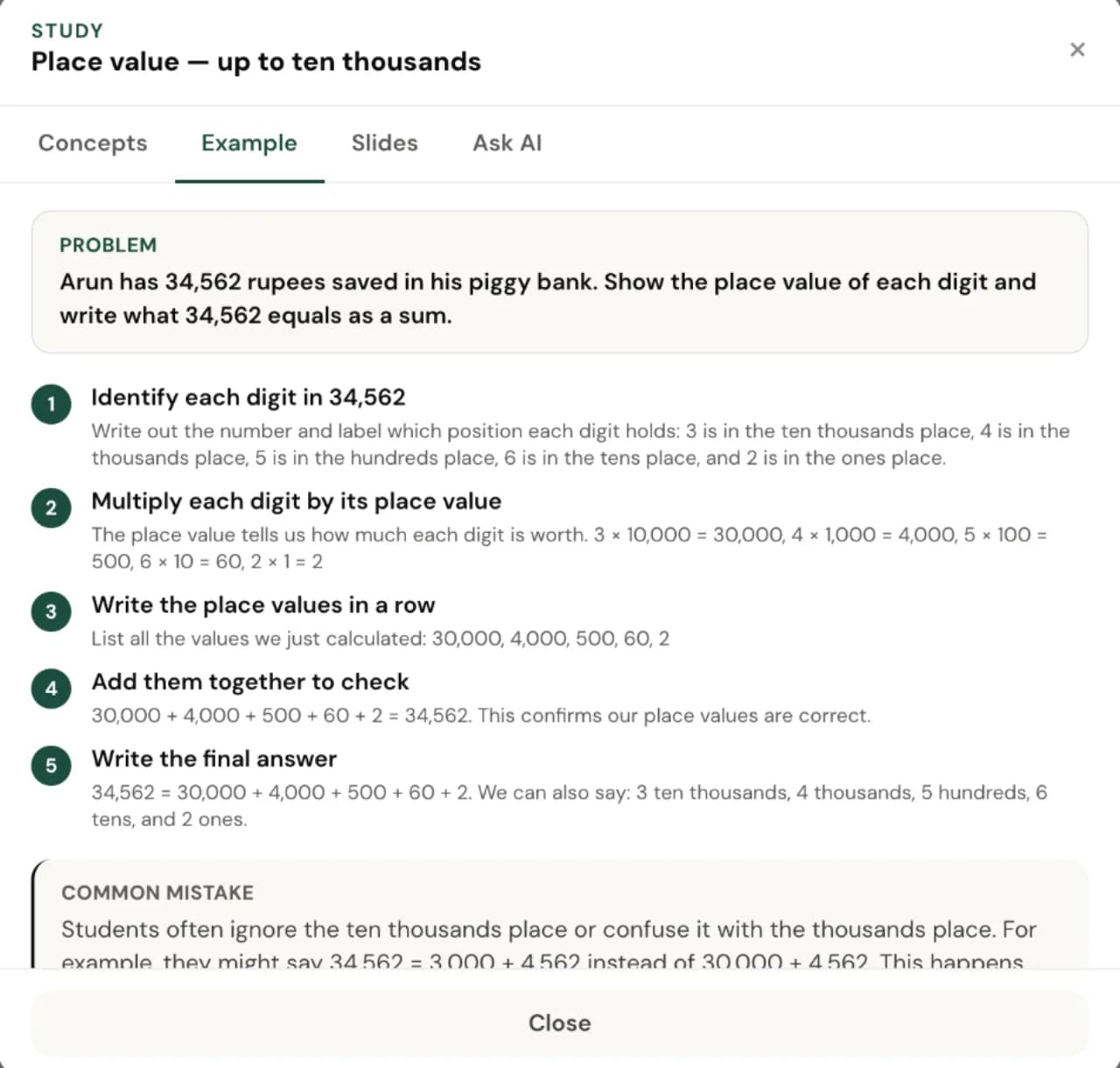
See a worked example
The Example view breaks a problem into steps, showing not just the final answer but how to reason through the problem.
Students can see the sequence: identify the relevant information, choose an approach, work through it, check the result, and recognise common mistakes.
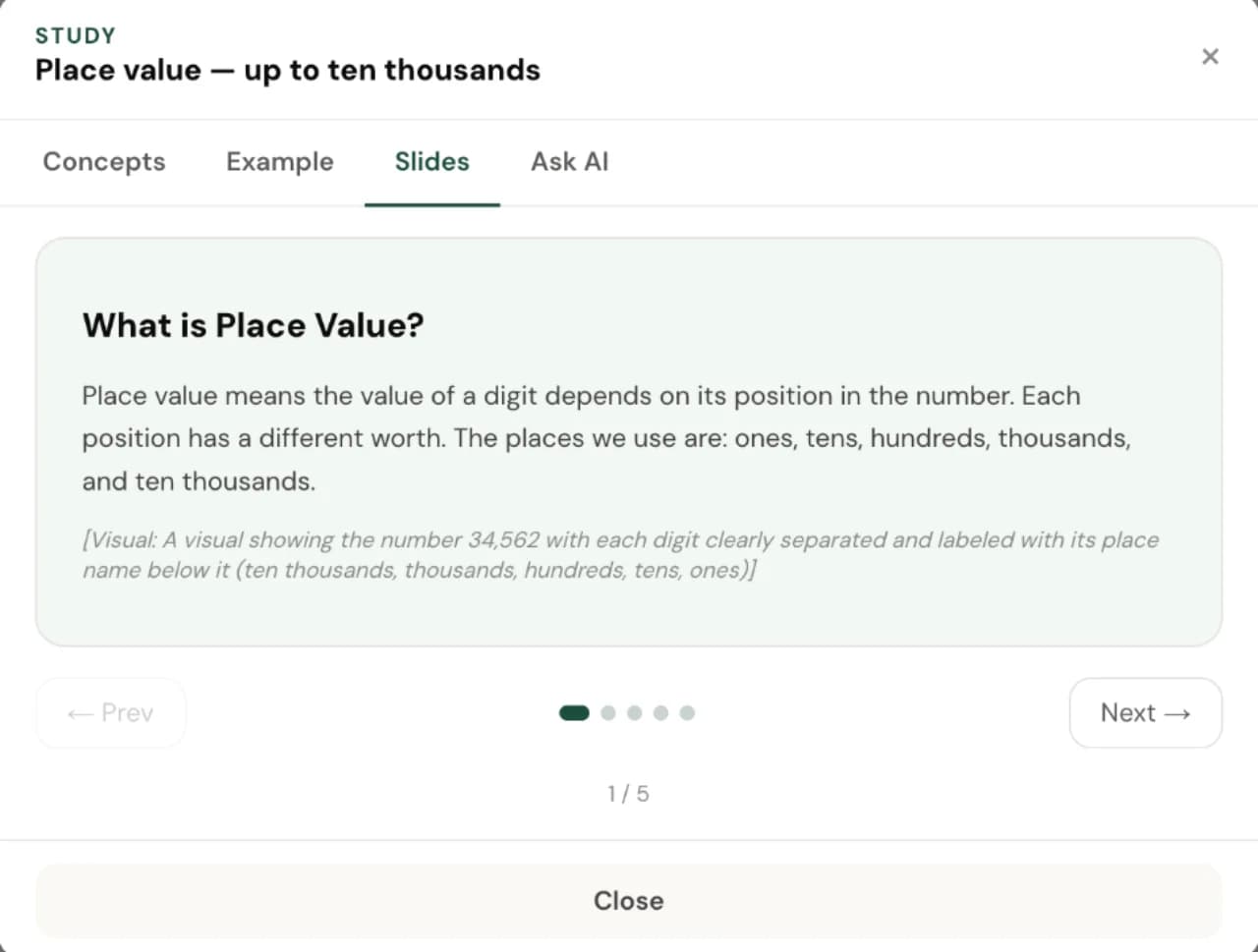
Learn visually with slides
The Slides view turns a concept into a short sequence of visual explanations that can be revisited when a learner needs a refresher.
For Olympiad preparation, this creates a bridge between learning a concept and applying that concept to an unfamiliar question.
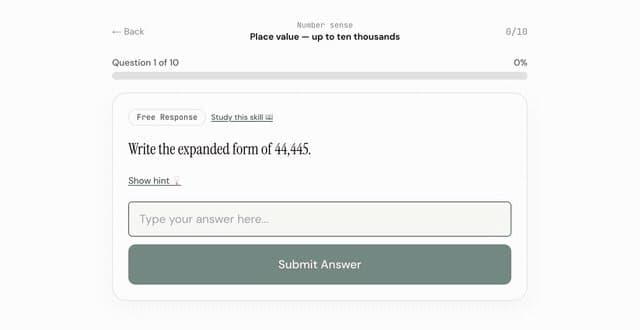
Ask AI when you need another explanation
The Ask AI option provides another path when a student is stuck and wants an explanation, hint or different way into a concept.
The objective is not to remove the challenge. It is to help the learner keep thinking and return to the problem with a better understanding.
What preparation actually involves
Most of the work is not learning new content.
It is building the habit of looking at an unfamiliar problem without freezing — trying a small case, drawing something, testing whether a pattern holds, and deciding what to try next.
Practice unfamiliar problem types
Routine questions build fluency. Unfamiliar questions build flexibility. Olympiad preparation needs both, but the second is where many students need deliberate practice.
- Problems where the method is not immediately obvious
- Hints that open up an approach rather than give away the step
- Practice that rewards reasoning and strategy
Change the response to “I’m stuck.”
A strong problem solver does not need to know the answer immediately. They need to know what they can try next.
- Try a smaller case
- Draw a diagram
- Look for a pattern
- Work backwards
Scheduling
Prepare backwards from the exam date.
Because the exam date is fixed, preparation can be organised around it. Earlier topics can be revisited at widening intervals instead of disappearing after one session.
Start with the date
Work backwards from the actual exam date and define what needs to be comfortable by then.
Build foundations
Make sure prerequisite school mathematics is stable before increasing the difficulty.
Revisit earlier learning
Return to concepts across several weeks so they are retrieved and applied again.
Increase challenge
As the exam approaches, bring together reasoning, accuracy, unfamiliarity and time awareness.
Who this suits
Good challenge starts from the right foundation.
Best suited for
Children already comfortable with their year's school mathematics who want something that stretches their problem-solving ability.
Not the right starting point
A child currently struggling with the school syllabus should close prerequisite gaps first. Curriculum or board-focused learning is the better starting point.
Comparison
Olympiad preparation vs. regular school practice
School mathematics builds the foundation. Olympiad preparation asks students to use that foundation more flexibly.
| Regular school practice | Olympiad preparation |
|---|---|
| Focuses on learning and applying syllabus concepts | Focuses on applying known concepts in unfamiliar situations |
| Questions often indicate the method or topic | Questions may require the student to identify the relevant idea |
| Repetition builds procedural fluency | Variety builds flexibility and problem-solving habits |
| The path to the answer may be familiar | The starting point may not be obvious |
| Accuracy and understanding of taught methods are important | Reasoning and strategy selection become increasingly important |
Frequently asked questions
Questions parents ask about Olympiad preparation
What is Olympiad preparation?
Olympiad preparation is practice designed to help students solve mathematical problems that require more reasoning, interpretation and strategy than routine school exercises.
Is Olympiad maths harder than school maths?
Olympiad problems often use concepts students already know from school, but they may require students to identify which concept applies and how to use it in an unfamiliar situation.
What classes does Sophoz Olympiad preparation cover?
Sophoz Olympiad preparation covers Classes 1 through 12. There are IMO, ISO and IEO pages for every class, maths practice for every class, and science and English practice up to Class 10.
How should a child prepare for an Olympiad?
Preparation should include unfamiliar problems, regular review, and practice with different problem-solving approaches, with preparation planned around the exam date.
Why does my child know the maths but still struggle with Olympiad questions?
Knowing a mathematical procedure and knowing when to use it are different skills. Olympiad questions often require students to recognise the relevant concept and decide how to approach the problem.
Why isn't my child's Olympiad score improving?
A score plateau can be a sign that the learner needs more targeted practice rather than simply more questions. Reviewing recurring mistakes and practising the underlying reasoning can be more useful than repeating familiar question types.
Should my child prepare for Olympiads if they are struggling with school maths?
The school syllabus should come first. Sophoz Olympiad preparation is intended for children who are already comfortable with the mathematics of their year and want additional challenge.
How is Olympiad preparation different from a question bank?
A question bank primarily provides questions. An Olympiad preparation approach should deliberately expose students to unfamiliar problem structures, reasoning, review and a preparation schedule built around the exam date.
By class
- IMO Class 1
- IMO Class 2
- IMO Class 3
- IMO Class 4
- IMO Class 5
- IMO Class 6
- IMO Class 7
- IMO Class 8
- IMO Class 9
- IMO Class 10
- IMO Class 11
- IMO Class 12
- ISO Class 1
- ISO Class 2
- ISO Class 3
- ISO Class 4
- ISO Class 5
- ISO Class 6
- ISO Class 7
- ISO Class 8
- ISO Class 9
- ISO Class 10
- ISO Class 11
- ISO Class 12
- IEO Class 1
- IEO Class 2
- IEO Class 3
- IEO Class 4
- IEO Class 5
- IEO Class 6
- IEO Class 7
- IEO Class 8
- IEO Class 9
- IEO Class 10
- IEO Class 11
- IEO Class 12
Turn curiosity into capability.
Help your child become more comfortable solving problems they have never seen before.