
Vedic Maths Programme
Make mental calculation faster, then make the improvement visible.
Mental calculation techniques that make arithmetic fast, practised to fluency, then measured honestly.
What Vedic Maths is
Arithmetic techniques that can be done in your head.
Vedic Maths is a set of techniques for doing arithmetic mentally and quickly. Multiplying two-digit numbers, squaring numbers ending in five, and checking a result without redoing the entire calculation are examples of the kinds of operations the programme can practise.
Practised properly, a child can become noticeably faster. The important word is practised. Knowing a technique once is different from retrieving and applying it fluently.
“Fast calculation is useful. Understanding why it works is still essential.”
What it is good for, honestly
Two clear benefits, without overselling the technique.
Make arithmetic faster
When basic calculations become more fluent, a child can spend less attention on the mechanics of arithmetic and more attention on the problem itself.
The value is not speed as a trophy. It is freeing attention when working through ordinary mathematics.
Build confidence quickly
Vedic Maths can produce a visible improvement within a relatively short period. For a child who has started to think of themselves as “bad at maths”, seeing themselves become faster can be meaningful.
That confidence is a useful outcome, but it should sit alongside genuine understanding.
What it does not replace
A faster calculation is not the same thing as understanding.
Sophoz does not present Vedic Maths as a substitute for conceptual mathematics. A child who can square a number quickly but cannot explain why the method works has learned a technique. That is useful, but it is not the whole of mathematical understanding.
Technique
Learn an efficient method for a calculation.
Fluency
Practise until the method can be retrieved without hesitation.
Understanding
Know what the technique is doing rather than treating it as a magic trick.
Application
Know when a mental method is useful and when another mathematical approach is better.
How it is practised
Short, frequent, timed retrieval.
The programme uses the kind of practice the skill actually demands. Instead of one long session, learners return frequently and retrieve methods repeatedly.
Retrieve, do not just read
The student needs to produce the calculation mentally. Watching an explanation can introduce a method, but retrieval is what turns the method into a usable skill.
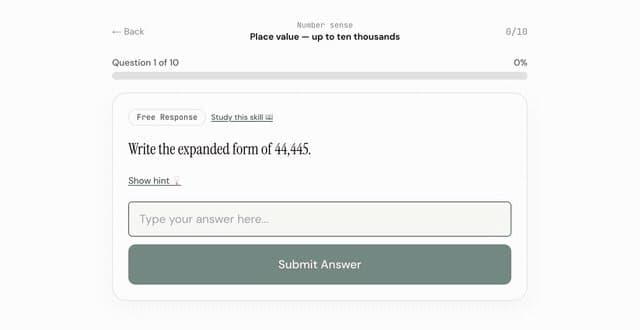
Mix methods instead of drilling one
Each session mixes methods rather than drilling one technique in isolation.
Mixed practice can feel slower because the child has to decide which method applies. That is precisely what makes the retrieval more useful over time.
Measure speed and accuracy
Speed without accuracy is not the goal. The useful measure is how quickly and reliably the child can perform the technique.
The weekly report makes that change visible across repeated practice rather than relying on a single impressive session.
What progress can look like
The child should become faster without becoming careless.
Because Vedic Maths is a fluency skill, progress should be visible in repeated performance. A useful trend is greater speed while maintaining accuracy.
Learn
Understand the technique and what it is doing.
Practise
Retrieve the technique through short, frequent sessions.
Mix
Decide which method applies instead of following a single repeated pattern.
Measure
Compare speed and accuracy over time.
Vedic Maths and school mathematics
Use fluency to make room for the thinking.
Vedic Maths is not intended to replace school mathematics. It can support it by making some arithmetic operations more automatic, leaving more attention available for the parts of a problem that require reasoning.
| Vedic Maths practice | School mathematics |
|---|---|
| Focuses on mental calculation techniques | Builds broader mathematical concepts and procedures |
| Prioritises retrieval, speed and accuracy | Prioritises understanding, application and problem-solving |
| Can make familiar calculations more fluent | Provides the wider mathematical foundation |
| Benefits from short, repeated practice | Includes lessons, exercises, applications and assessment |
Who this suits
For children ready to become noticeably more fluent with numbers.
A strong fit
- Students in Classes 3 through 8
- Children who enjoy fast mental challenges
- Students who want greater calculation fluency
- Children who benefit from visible progress
The right expectation
The aim is to become faster and more fluent with arithmetic, while keeping mathematical understanding intact. Vedic Maths is one part of a broader mathematics education.
Frequently asked questions
Questions parents ask about Vedic Maths
What is Vedic Maths?
Vedic Maths is a set of techniques for doing arithmetic in your head quickly, including methods for multiplication, squaring and checking calculations.
What classes does Sophoz Vedic Maths cover?
The programme covers Classes 3 through 8.
What is Vedic Maths good for?
It can make arithmetic faster and can build confidence through visible improvement in mental calculation.
Does Vedic Maths replace conceptual understanding?
No. A technique can make a calculation faster without replacing the need to understand the underlying mathematics.
How is Vedic Maths practised?
The programme uses short, frequent, timed retrieval and mixes methods rather than repeatedly drilling only one method.
Why mix methods instead of practising one technique?
Mixing methods requires the learner to decide which technique applies. This can feel harder at first, but it makes retrieval and selection part of the practice.
How do parents measure progress?
The weekly report shows speed and accuracy over time, making improvement visible across repeated practice.
Can Vedic Maths help with school mathematics?
Greater arithmetic fluency can free attention for other parts of a mathematical problem, but Vedic Maths should complement rather than replace conceptual learning.
Make the calculation faster. Keep the mathematics clear.
Give your child a structured way to practise mental arithmetic and see the gains over time.