
Beyond Olympiads: Building Skills for the Future
By The Sophoz Curriculum Team
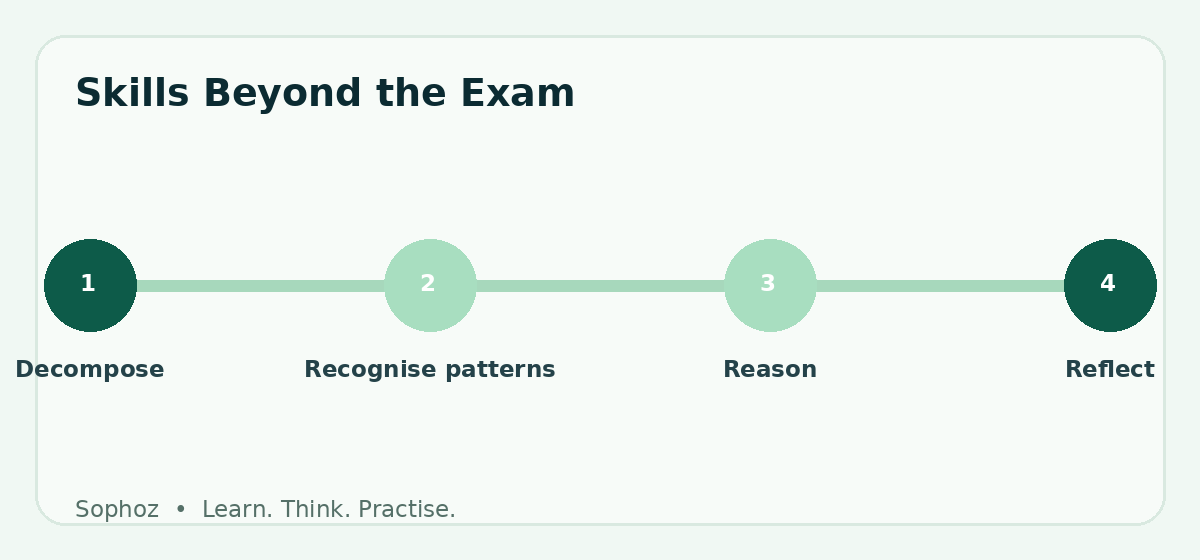
The goal is not more worksheets. It is stronger understanding, better decisions and more independent problem solving.
The exam is a milestone, not the destination
An Olympiad can be exciting, challenging and motivating. But the most valuable outcomes are not confined to the result sheet. Good preparation can give a learner repeated practice in approaching unfamiliar problems, checking assumptions and learning from failed attempts.
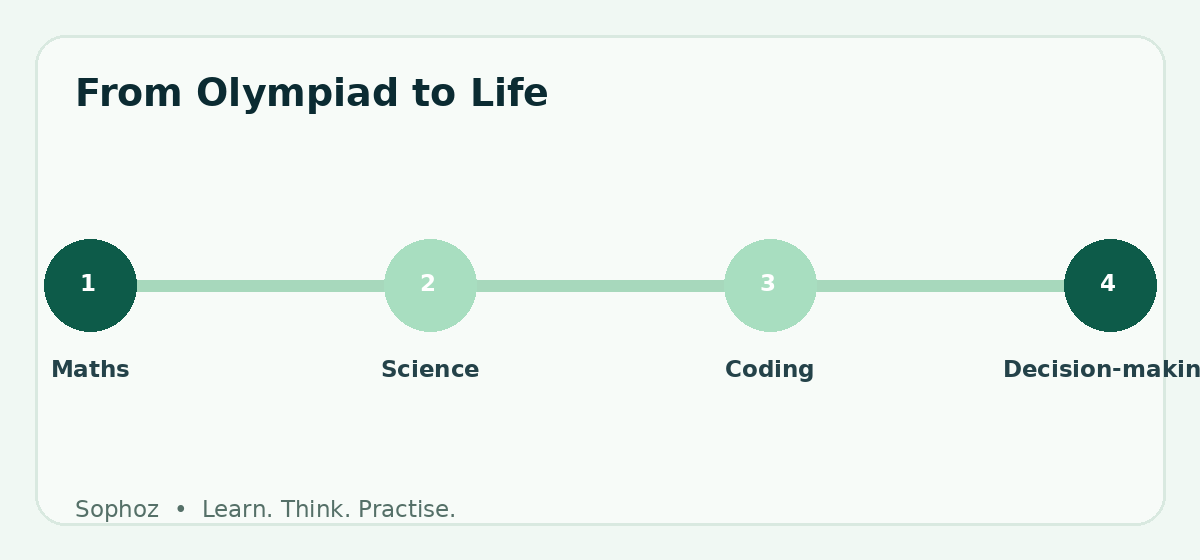
Those habits travel. They appear later in science, coding, writing, design, research and everyday decision-making.
Problem decomposition
A difficult question often becomes manageable when it is broken into smaller questions. What is known? What is unknown? Which part can be solved first? What relationship connects the pieces?
This is problem decomposition. It is central to mathematics, but it is equally useful when planning a project, debugging code or investigating why an experiment produced an unexpected result.
Pattern recognition
Olympiad problems frequently reward noticing structure: repetition, symmetry, invariants, sequences or relationships. Learners begin to ask what changes and what stays the same.
Pattern recognition is not a mystical talent. It improves when students see varied examples, compare cases and explain the rule they believe is operating.
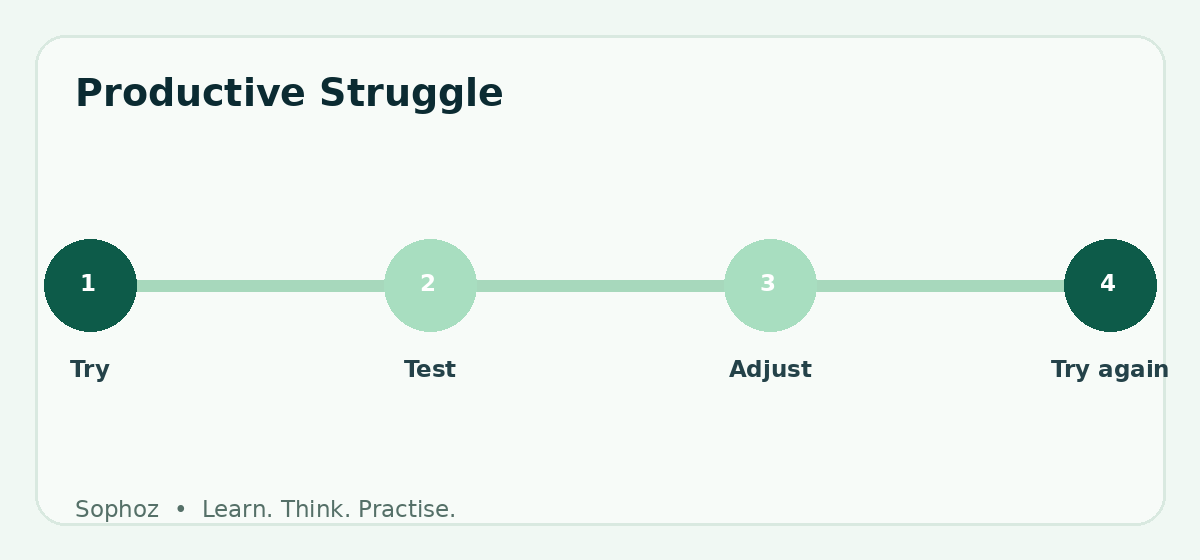
Productive struggle
A learner who expects every answer to be immediate can interpret difficulty as evidence of inability. Carefully chosen challenging problems teach another response: try a representation, simplify the case, test an assumption, seek a small hint and try again.
The word 'productive' matters. Struggle should still contain progress. Problems that are far beyond the learner's knowledge can create frustration rather than growth.
Reasoning and communication
Getting the answer is only part of mathematical competence. Explaining why it works forces a learner to organise ideas and expose hidden gaps.
Ask children to explain a solution in ordinary language, draw a diagram or compare two methods. The ability to communicate reasoning becomes increasingly important as academic work becomes more complex.
Metacognition and self-directed learning
An error log is a simple form of metacognition: the learner thinks about how they learn. Planning revision, identifying weak areas and deciding what to practise next are early steps toward self-directed learning.
A child who can say 'I understand the concept, but I rush the last step' has a more actionable problem than a child who simply says 'I am bad at this'.
Decision-making under constraints
Timed papers introduce constraints. The learner has limited time and must decide where to invest it. Good preparation teaches prioritisation rather than frantic speed.
That ability—to allocate attention based on value and difficulty—is useful far beyond an exam hall.
Keep competition in perspective
Olympiads are one form of challenge. They should not become a complete definition of a child's ability or future. Reading widely, building things, playing sport, making art, collaborating with others and exploring personal interests develop capabilities that a mathematics paper cannot measure.
The healthiest interpretation is that an Olympiad is a laboratory for certain skills, not a verdict on the whole learner.
A better long-term question
Instead of asking only 'What rank did you get?', ask: Are you more comfortable with unfamiliar problems? Do you know how to learn from an error? Can you explain your thinking? Are you becoming more independent?
Those questions keep the focus on capabilities that remain useful long after the certificate is filed away.
A practical way to use this guidance at home
Choose one small change rather than rebuilding the entire routine in a day. For example, introduce a five-minute retrieval warm-up, begin an error log, or replace one chapter-labelled worksheet with a mixed set. Use the change consistently for two weeks and observe what happens.
Parents should look for behavioural evidence as well as scores. Does the learner begin work with less prompting? Do they explain ideas more clearly? Are the same mistakes recurring less often? Can they identify what they find difficult? These indicators help distinguish productive practice from mere activity.
Keep the environment simple. A clear desk, the required materials, a visible timer when timing is appropriate and a defined end point can reduce negotiation. Finish while the learner still has some energy rather than extending every session until attention disappears.
Questions parents can ask after practice
Useful questions keep the focus on learning: Which question required the most thinking? What clue helped you? Where did your first approach fail? Which mistake would you recognise faster next time? Can you explain one solution without looking at your notes?
Avoid turning reflection into interrogation. One or two questions are enough. The aim is to help the child notice their own thinking so that strategies gradually become self-directed.
Over time, invite the learner to choose part of the next session. They might select a weak topic to revisit or a problem they want to retry. Small choices can increase ownership without removing structure.
What success should mean
A competition naturally produces scores and ranks, but preparation can be judged more broadly. A successful learner becomes more accurate, more strategic and more willing to engage with unfamiliar material. They recover from errors faster and need fewer external prompts.
Those capabilities are valuable even when a particular paper is unusually difficult. They also reduce the temptation to treat one result as a permanent label.
Use the exam as a checkpoint. After it, discuss what worked, what the learner would change and which kinds of problems they would still enjoy exploring. That turns a one-day event into useful information for future learning.
A final note for families
Preparation works best when it remains proportionate to the child's age and wider life. The purpose of structured practice is to make thinking clearer, not to fill every free hour. Keep expectations explicit, feedback specific and the routine predictable.
When a learner struggles, diagnose before increasing pressure. When a learner succeeds, ask what strategy contributed. In both cases, direct attention toward processes that can be repeated. That is how an exam-specific routine can contribute to a more general ability to learn independently.
Revisit the plan regularly. What was appropriate four weeks ago may no longer be the best use of time today. Strong learning plans are responsive: they preserve what is working, remove what is not and keep the next challenge within reach.
Sources and further reading
- SOF IMO Class 6 syllabus and pattern
- SOF IMO 2026–27 overview
- SOF Class 6 IMO preparation guide
- SOF Class 6 Science syllabus
- Education Endowment Foundation: cognitive science in practice
Exam details can change. Always verify the current syllabus, dates and pattern with the official organiser.