
How the Brain Learns (and How to Use It)
By The Sophoz Curriculum Team
The goal is not more worksheets. It is stronger understanding, better decisions and more independent problem solving.
Learning is not the same as seeing
Reading a page twice can make it feel familiar. Watching a teacher solve a problem can make the method feel obvious. But familiarity is a poor test of whether the learner can retrieve and use the idea tomorrow.
A better test is performance without the support. Close the book and explain the concept. Solve a related question without copying the example. Write down what you remember before checking. The gap between 'I recognise this' and 'I can produce this' is central to effective study.
Retrieval practice: bring knowledge back
Retrieval practice means trying to recall information from memory rather than repeatedly looking at it. It can be as simple as a five-question low-stakes quiz, explaining yesterday's idea without notes or writing everything remembered about a topic for two minutes.
The attempt matters even when recall is incomplete. Check the answer, correct misunderstandings and retrieve again later. The goal is not to turn every lesson into a test; it is to give memory regular opportunities to work.
Spacing: revisit after a gap
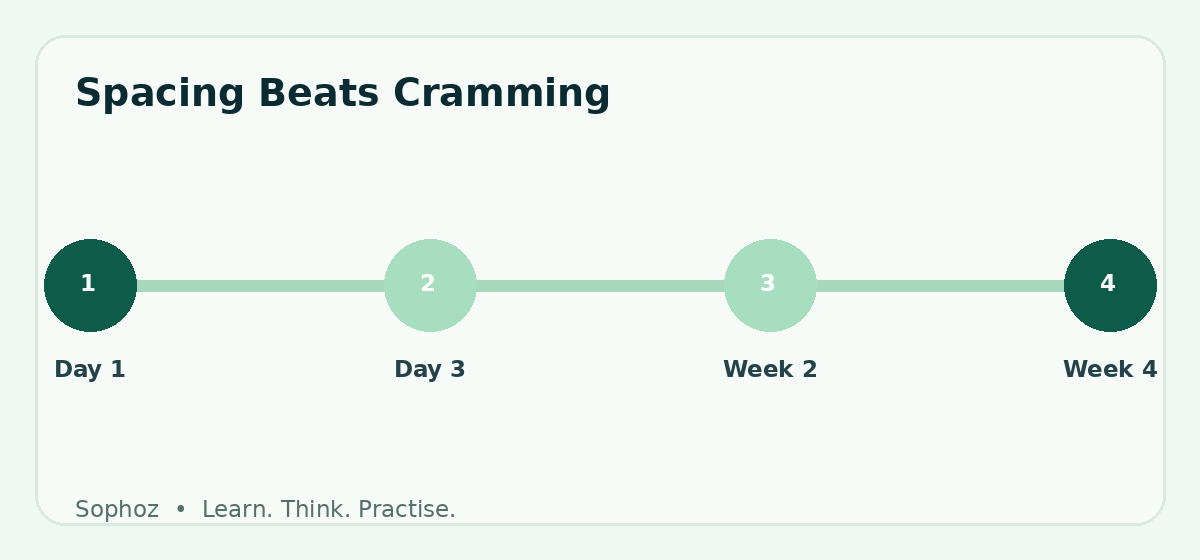
Cramming can produce short-term fluency, but learning needs to remain available after time has passed. Spacing means revisiting important ideas across days and weeks.
For a Class 6 learner, that might mean bringing two fraction questions into next week's mixed set, then returning again two weeks later. The learner has to reconstruct the knowledge rather than relying on the freshness of yesterday's lesson.
Interleaving: practise choosing the method
Blocked practice groups many similar questions together. It is useful when a method is brand new because the learner can focus on execution. Interleaving mixes question types so the learner must first decide what kind of problem they are facing.
That decision can make practice feel harder. Harder practice is not automatically better, but once foundations are secure, carefully mixed practice can help learners recognise when different methods apply.
Worked examples: reduce unnecessary overload
When a topic is new, asking a learner to discover every step from scratch can consume attention that should be used to understand the underlying structure. A clear worked example can show how an expert organises the problem.
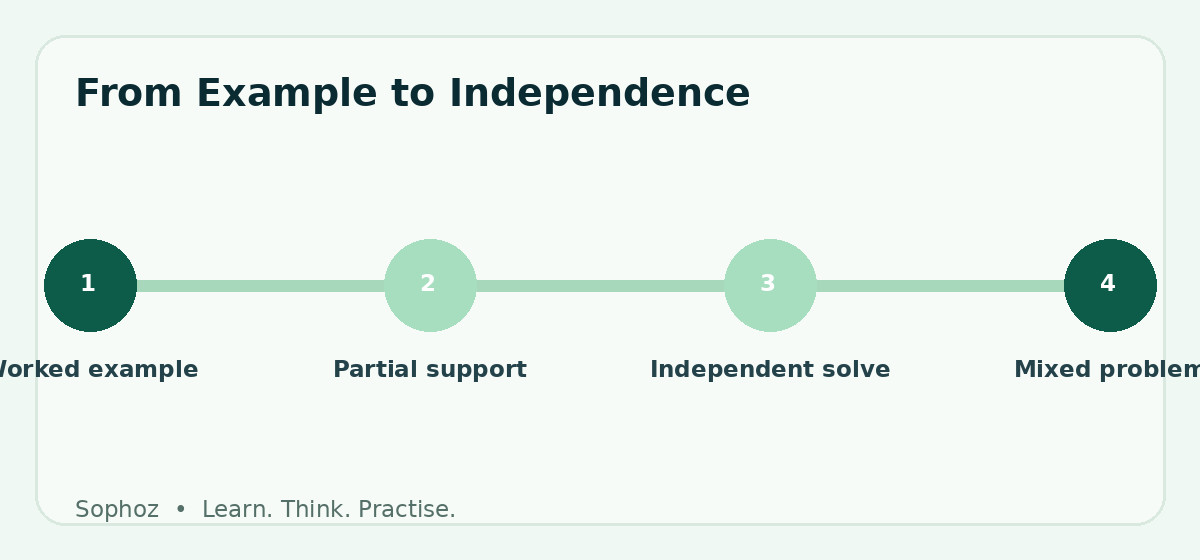
A useful progression is: study a worked example; explain why each step is present; complete a partially worked example; solve a similar problem independently; then solve a varied problem that requires choosing the method.
Feedback: identify the cause, not just the result
A red cross tells a learner that the answer is wrong. It does not tell them what to change. Better feedback points to the relevant cause: a condition was missed, a diagram was interpreted incorrectly, a calculation slipped or a strategy was unsuitable.
Feedback is strongest when the learner acts on it. After a cue or explanation, ask for another attempt or a similar question. Correction should lead back into thinking.
Cognitive load and clear explanations
Working memory is limited. A cluttered explanation, too many simultaneous steps or unnecessary visual detail can make a simple concept difficult to process. Good teaching reduces avoidable complexity while keeping the important thinking.
This is one reason visual aids should clarify rather than decorate. A diagram is useful when it makes relationships visible; it is not automatically useful because it is colourful.
Sleep, attention and breaks
Study strategies cannot compensate for chronic tiredness or constant distraction. Attention is the gateway to learning, and sleep supports memory processes. Short focused sessions with breaks can be more productive than long sessions in which concentration has already collapsed.
For parents, protecting sleep may sometimes be a better exam-preparation decision than adding another late worksheet.
A practical learning cycle
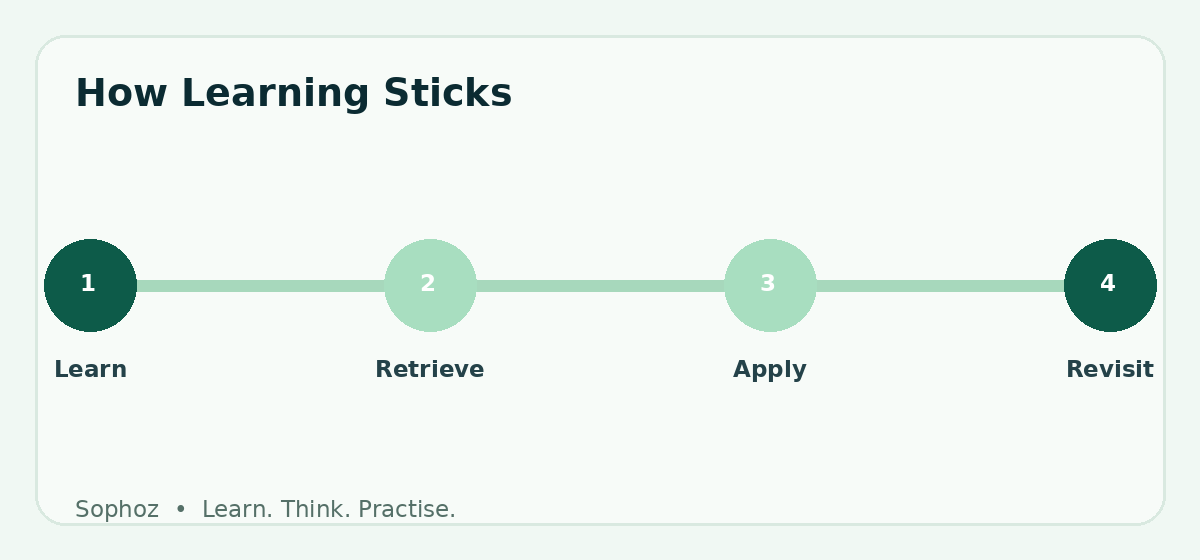
A simple cycle can bring these ideas together: learn a small concept; study a clear example; retrieve the idea without notes; solve a varied problem; receive specific feedback; revisit the idea after a gap.
None of these techniques is magic. Their value comes from using them thoughtfully, in the right sequence and with material appropriate to the learner.
A practical way to use this guidance at home
Choose one small change rather than rebuilding the entire routine in a day. For example, introduce a five-minute retrieval warm-up, begin an error log, or replace one chapter-labelled worksheet with a mixed set. Use the change consistently for two weeks and observe what happens.
Parents should look for behavioural evidence as well as scores. Does the learner begin work with less prompting? Do they explain ideas more clearly? Are the same mistakes recurring less often? Can they identify what they find difficult? These indicators help distinguish productive practice from mere activity.
Keep the environment simple. A clear desk, the required materials, a visible timer when timing is appropriate and a defined end point can reduce negotiation. Finish while the learner still has some energy rather than extending every session until attention disappears.
Questions parents can ask after practice
Useful questions keep the focus on learning: Which question required the most thinking? What clue helped you? Where did your first approach fail? Which mistake would you recognise faster next time? Can you explain one solution without looking at your notes?
Avoid turning reflection into interrogation. One or two questions are enough. The aim is to help the child notice their own thinking so that strategies gradually become self-directed.
Over time, invite the learner to choose part of the next session. They might select a weak topic to revisit or a problem they want to retry. Small choices can increase ownership without removing structure.
What success should mean
A competition naturally produces scores and ranks, but preparation can be judged more broadly. A successful learner becomes more accurate, more strategic and more willing to engage with unfamiliar material. They recover from errors faster and need fewer external prompts.
Those capabilities are valuable even when a particular paper is unusually difficult. They also reduce the temptation to treat one result as a permanent label.
Use the exam as a checkpoint. After it, discuss what worked, what the learner would change and which kinds of problems they would still enjoy exploring. That turns a one-day event into useful information for future learning.
A final note for families
Preparation works best when it remains proportionate to the child's age and wider life. The purpose of structured practice is to make thinking clearer, not to fill every free hour. Keep expectations explicit, feedback specific and the routine predictable.
When a learner struggles, diagnose before increasing pressure. When a learner succeeds, ask what strategy contributed. In both cases, direct attention toward processes that can be repeated. That is how an exam-specific routine can contribute to a more general ability to learn independently.
Revisit the plan regularly. What was appropriate four weeks ago may no longer be the best use of time today. Strong learning plans are responsive: they preserve what is working, remove what is not and keep the next challenge within reach.
Sources and further reading
- SOF IMO Class 6 syllabus and pattern
- SOF IMO 2026–27 overview
- SOF Class 6 IMO preparation guide
- SOF Class 6 Science syllabus
- Education Endowment Foundation: cognitive science in practice
Exam details can change. Always verify the current syllabus, dates and pattern with the official organiser.