
How to Prepare for Olympiads: A Complete Guide for Parents and Students
By The Sophoz Curriculum Team
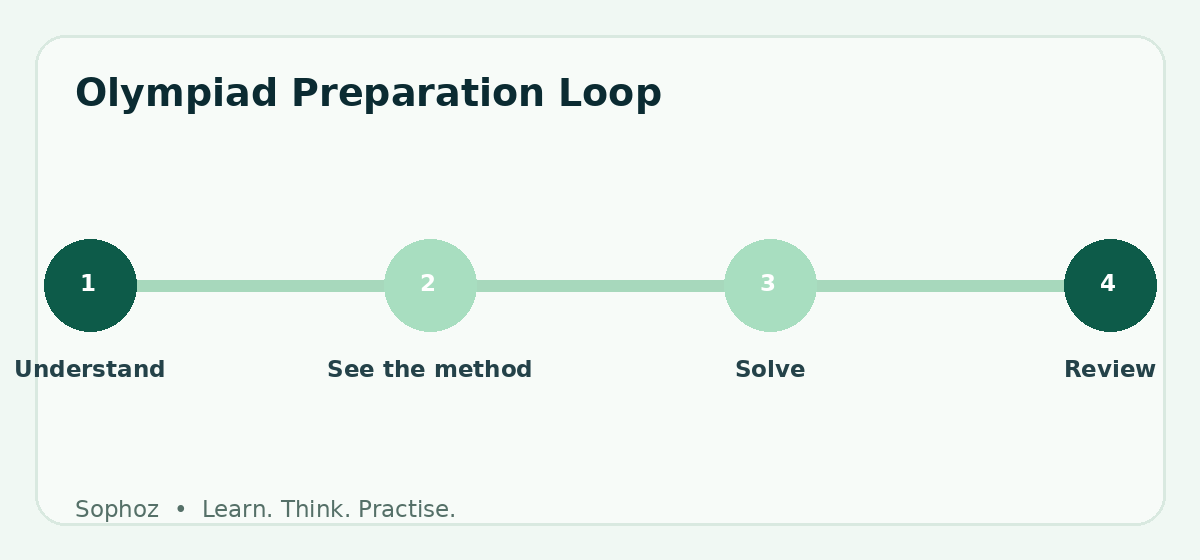
The goal is not more worksheets. It is stronger understanding, better decisions and more independent problem solving.
Olympiad preparation is not the same as school revision
A child can do very well in school mathematics and still find an Olympiad paper surprisingly unfamiliar. That is not a contradiction. School assessments often reward accurate use of a method that has recently been taught. Olympiad questions are more likely to hide the method inside a pattern, a story, a diagram or an unusual combination of ideas. The learner has to decide what knowledge applies before using it.
That difference should shape the entire preparation plan. The goal is not to push a child several grades ahead or make them memorise a collection of tricks. It is to make familiar knowledge more flexible. Strong preparation repeatedly asks the learner to understand a concept, see a method, apply it in a new setting and explain why the solution works.
This is also why simply increasing the number of worksheets can disappoint. Fifty near-identical questions may improve fluency with one visible procedure, but they do not necessarily prepare a learner to recognise that procedure when the next question looks different. Olympiad practice should contain variation, reflection and opportunities to choose a strategy.
Step 1: establish a clear baseline
Start with a short diagnostic rather than a large study timetable. Use a mixed set that samples the main areas relevant to the child's class and target exam. Do not help during the first attempt. The purpose is to see what the learner can retrieve and apply independently.
Classify the results into three broad groups: secure concepts, developing concepts and genuine foundation gaps. Also classify the mistakes. Was the concept unknown? Was the question misread? Did the learner choose an unsuitable method? Was the reasoning correct but the calculation inaccurate? Did the child know what to do but run out of time?
These distinctions matter because they lead to different actions. A concept gap needs teaching. A reading error needs slower interpretation and annotation. A strategy problem needs exposure to varied examples. A calculation error may need written working and checking habits. A pacing issue should be addressed only after accuracy is reasonably stable.
Step 2: use an 8–12 week preparation rhythm
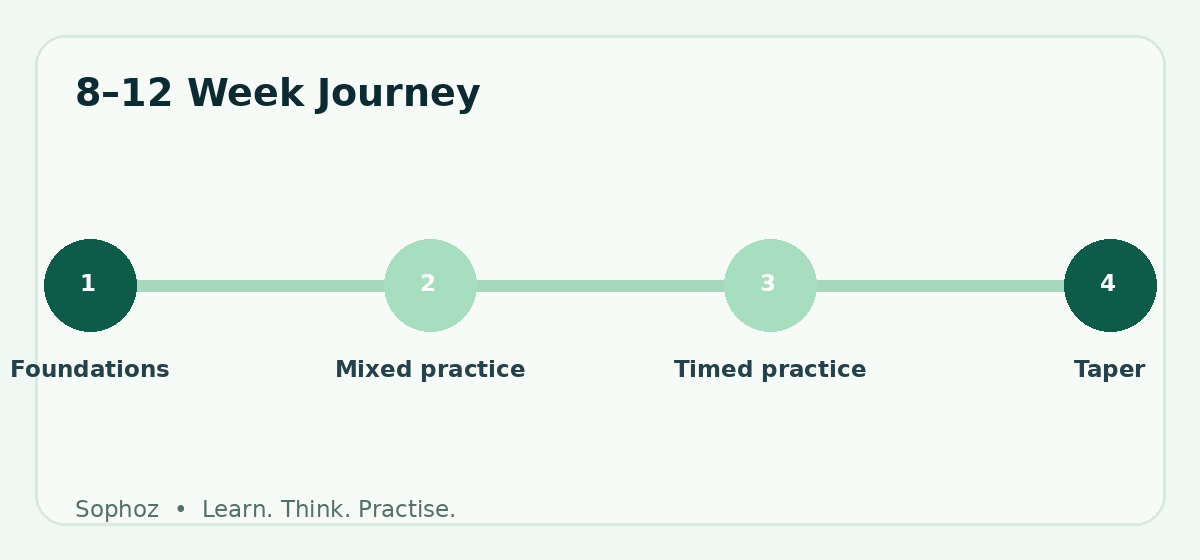
For many school-level Olympiads, eight to twelve weeks is enough time to create a purposeful preparation cycle without turning the exam into a year-long project. In the first phase, confirm school-level foundations and introduce the major question families. In the middle phase, mix topics and increase novelty. In the final phase, add timed sections, full papers and systematic error review.
A sustainable week for many Class 6 learners can contain three or four focused sessions of roughly 30–40 minutes. One session might review a concept and worked example. A second can use mixed problems. A third can revisit mistakes and older topics. A fourth, when appropriate, can be a timed mini-test or puzzle session.
The exact number of minutes is less important than attention. Thirty concentrated minutes with feedback are usually more valuable than an hour in which the learner is tired, distracted or completing questions mechanically.
Step 3: teach a repeatable way to attack unfamiliar questions
Children often believe good problem solvers simply 'see' the answer. In reality, they use habits that can be taught. A useful routine is: read the problem once for meaning; read again for mathematical information; state what is being asked; represent the information; choose a possible strategy; solve; and check whether the answer fits the conditions.
Representation deserves special attention. A quick table can reveal a pattern. A bar model can clarify a relationship. A number line can make distance or ordering visible. A diagram can expose hidden geometry. Listing small cases can turn an abstract counting problem into something concrete.
Parents and teachers can support this process without giving away the method. Instead of saying 'use fractions', ask: What information matters? Can you draw it? What happens in a simpler case? What have you tried already? What would make an answer impossible? These prompts preserve the learner's ownership of the solution.
Step 4: make mistakes part of the curriculum
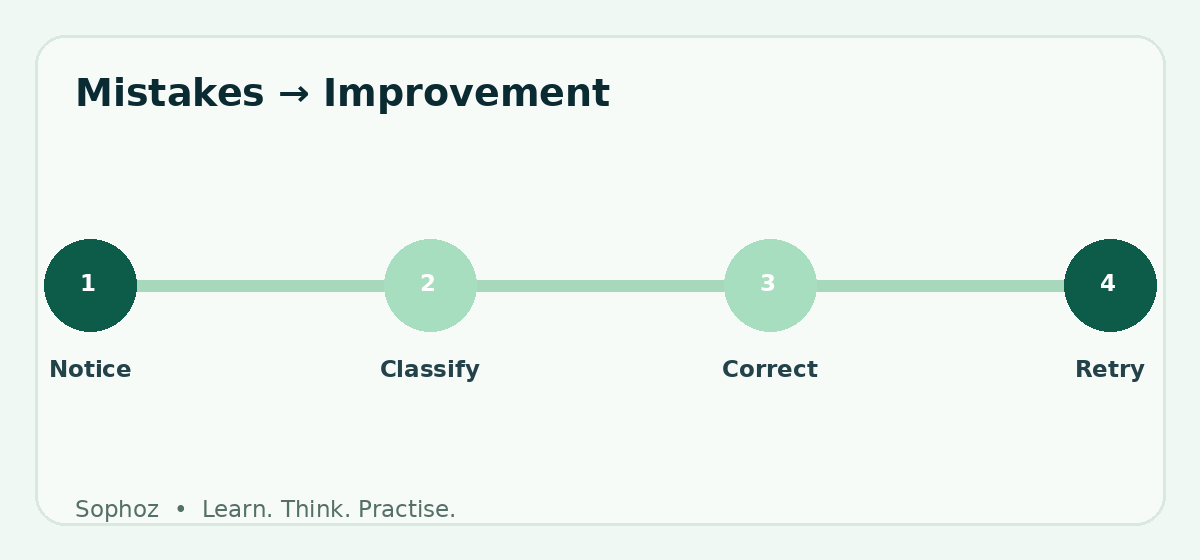
A wrong answer is useful only if the learner understands what produced it. Keep a compact error log. For each important mistake, record the question type, the cause of the error, the better approach and a date to retry a similar problem.
Over several weeks, patterns become visible. A learner may repeatedly ignore words such as 'exactly', 'at least' or 'different'. Another may begin calculations before understanding what the question asks. Another may solve correctly but fail to check units. These are trainable habits.
Do not correct everything with a long explanation. Sometimes the best feedback is a small cue followed by another attempt. The learner should do as much of the intellectual repair as possible. A corrected solution that the adult performs is less valuable than a solution the child reconstructs.
Step 5: move from accuracy to speed
Timing is important in a competitive paper, but it should not dominate early preparation. If a learner is still discovering how to solve a question family, aggressive timing can reward guessing and hurried reading. Begin untimed. When accuracy becomes dependable, time small sets. Only later introduce complete papers under realistic conditions.
Teach exam decisions as a separate skill. A child should know when to continue, when to mark a question and return, and when an answer can be checked quickly through estimation or substitution. The aim is not to make every question equally fast. It is to protect the paper from one difficult question consuming too much time.
After a mock paper, review more than the score. Which questions were slow? Which were guessed? Which errors repeated? Which questions looked hard but became easy after a diagram? That information should determine the next week's practice.
What parents can do without creating pressure
Parents have an important role, but it is not to become the second examiner. Protect a regular routine, help the child organise materials and create an environment where difficult questions are normal. Praise useful behaviours: a clear diagram, a careful check, persistence after a failed approach and a good explanation.
Avoid comparing scores with classmates or treating every practice paper as a verdict. Competition can motivate some children, but constant ranking can shift attention away from learning. The most useful question after a session is often not 'What did you score?' but 'What did you learn about how you solve problems?'
If school-level mathematics is currently a struggle, prioritise those foundations before adding intensive Olympiad preparation. Challenge is productive when a learner has enough prior knowledge to make progress.
The final week
The last week is for consolidation, not panic. Revisit the error log, solve a few representative questions, complete a familiar timed set and confirm exam logistics. Avoid introducing large new topic lists simply because the date is close.
Sleep and attention matter. A well-rested learner who can read carefully and make good decisions is in a stronger position than a learner who completed one more late-night paper. The preparation has already done its work; the final week should help the child access it calmly.
A simple preparation checklist
Before exam day, ask whether the learner can explain the major concepts in their own words, solve mixed rather than only chapter-labelled questions, recognise common error patterns, work through a timed section without panic and recover when a question initially looks unfamiliar.
That is a more useful definition of readiness than completing a particular number of books. Olympiad preparation is successful when the child becomes a more independent problem solver — regardless of the eventual rank.
A practical way to use this guidance at home
Choose one small change rather than rebuilding the entire routine in a day. For example, introduce a five-minute retrieval warm-up, begin an error log, or replace one chapter-labelled worksheet with a mixed set. Use the change consistently for two weeks and observe what happens.
Parents should look for behavioural evidence as well as scores. Does the learner begin work with less prompting? Do they explain ideas more clearly? Are the same mistakes recurring less often? Can they identify what they find difficult? These indicators help distinguish productive practice from mere activity.
Keep the environment simple. A clear desk, the required materials, a visible timer when timing is appropriate and a defined end point can reduce negotiation. Finish while the learner still has some energy rather than extending every session until attention disappears.
Questions parents can ask after practice
Useful questions keep the focus on learning: Which question required the most thinking? What clue helped you? Where did your first approach fail? Which mistake would you recognise faster next time? Can you explain one solution without looking at your notes?
Avoid turning reflection into interrogation. One or two questions are enough. The aim is to help the child notice their own thinking so that strategies gradually become self-directed.
Over time, invite the learner to choose part of the next session. They might select a weak topic to revisit or a problem they want to retry. Small choices can increase ownership without removing structure.
What success should mean
A competition naturally produces scores and ranks, but preparation can be judged more broadly. A successful learner becomes more accurate, more strategic and more willing to engage with unfamiliar material. They recover from errors faster and need fewer external prompts.
Those capabilities are valuable even when a particular paper is unusually difficult. They also reduce the temptation to treat one result as a permanent label.
Use the exam as a checkpoint. After it, discuss what worked, what the learner would change and which kinds of problems they would still enjoy exploring. That turns a one-day event into useful information for future learning.
Sources and further reading
- SOF IMO Class 6 syllabus and pattern
- SOF IMO 2026–27 overview
- SOF Class 6 IMO preparation guide
- SOF Class 6 Science syllabus
- Education Endowment Foundation: cognitive science in practice
Exam details can change. Always verify the current syllabus, dates and pattern with the official organiser.