
IMO Class 6: Syllabus, Exam Pattern and Preparation Tips
By The Sophoz Curriculum Team
The goal is not more worksheets. It is stronger understanding, better decisions and more independent problem solving.
SOF IMO Class 6 at a glance
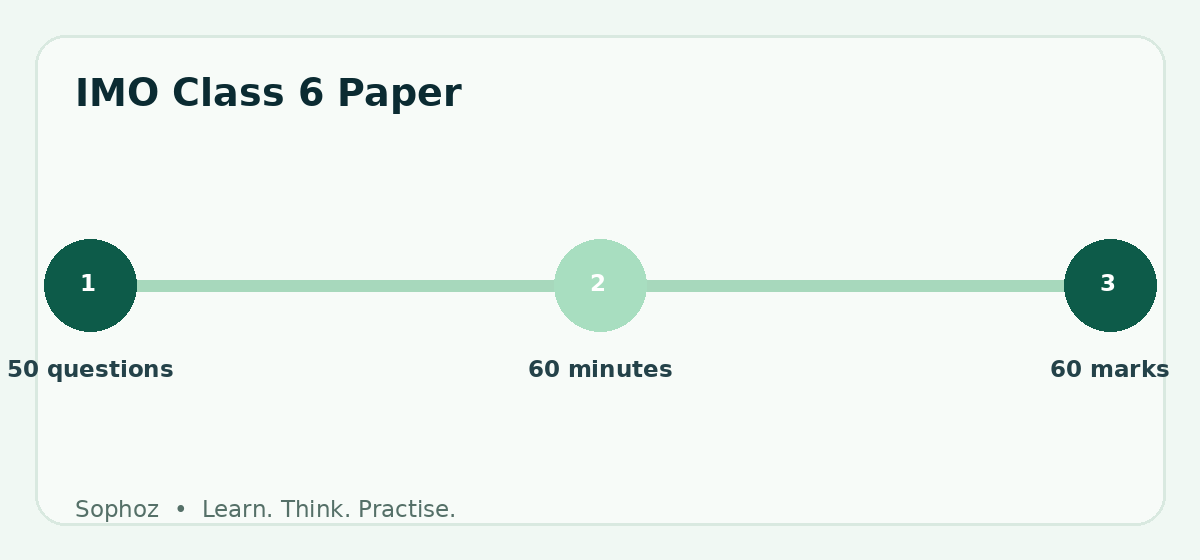
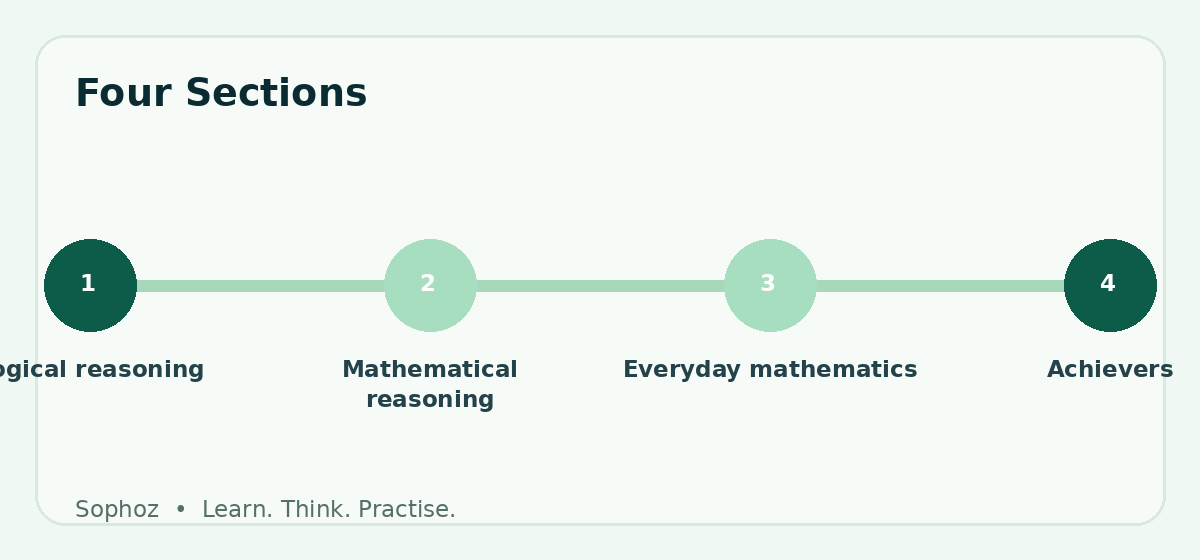
For the 2026–27 cycle, the Science Olympiad Foundation's official Class 6 IMO syllabus page states that the Level 1 paper has 50 questions, a duration of one hour and a total of 60 marks. The Class 5–10 Level 1 pattern is divided into Logical Reasoning, Mathematical Reasoning, Everyday Mathematics and the Achievers Section.
The official pattern lists 15 Logical Reasoning questions worth one mark each, 20 Mathematical Reasoning questions worth one mark each, 10 Everyday Mathematics questions worth one mark each and 5 Achievers questions worth three marks each. Because the Achievers questions carry more marks per question, they deserve thoughtful practice—but not at the expense of the rest of the paper.
The current Class 6 syllabus
The official 2026–27 Class 6 syllabus includes verbal and non-verbal reasoning plus mathematics topics such as Patterns in Mathematics, Lines and Angles, Number Play, Data Handling and Presentation, Prime Time, Perimeter and Area, Fractions, Playing with Constructions, Symmetry and The Other Side of Zero.
SOF also notes that Level 1 papers draw 60% of questions from the current class syllabus and 40% from the previous class syllabus, while the Achievers Section uses the current class syllabus. Parents should therefore avoid preparing from a Class 6 topic list in isolation. Revision of important Class 5 foundations belongs in the plan.
What the pattern means for preparation
A 50-question, 60-minute paper creates a decision-making challenge as well as a knowledge challenge. A learner cannot spend the same amount of time on every question. Practice should eventually teach scanning, prioritisation, sensible skipping and returning.
However, speed should come after understanding. In the first part of preparation, focus on accuracy and representations. Later, use timed mini-sections and full papers to develop pacing.
Build a topic map
Create a one-page map of the syllabus. For each topic, mark the learner as secure, developing or needs review. Add a separate row for reasoning and a separate row for previous-class foundations.
This simple map prevents a common mistake: spending equal time on every chapter. If symmetry is secure but fractions repeatedly cause errors, the plan should reflect that evidence.
Prepare reasoning explicitly
Reasoning should not be treated as an optional warm-up. Practise patterns, classification, sequences, spatial relationships and other forms that appear in the official reasoning syllabus. More importantly, ask the learner to explain the rule rather than merely choose an option.
The explanation reveals whether the child has identified the structure or guessed from surface similarity.
Use the Achievers Section intelligently
Higher-order questions often combine familiar concepts in less familiar ways. Build toward them. First make the relevant concept secure, then solve a worked example, then attempt varied problems and finally use Achievers-style questions under increasing time pressure.
If a child is missing basic fraction understanding, repeatedly attempting difficult fraction puzzles is unlikely to fix the foundation.
Mock papers and review
Use current-pattern mock papers later in the preparation cycle. Simulate the one-hour format when the learner is ready. Afterward, classify mistakes and identify slow questions.
The mock is not only a prediction of a score. It is a diagnostic snapshot of knowledge, reading, strategy and pacing.
2026–27 exam dates and verification
SOF's current overview lists three Level 1 dates for the 2026–27 IMO cycle: 23 October 2026, 26 November 2026 and 10 December 2026. Schools participate through the organiser's process, so families should confirm the date selected by their school.
Exam information can change. Before publishing or acting on dates, fees, syllabus or eligibility, check the current official SOF page rather than relying on an older blog or book.
A six-step preparation plan
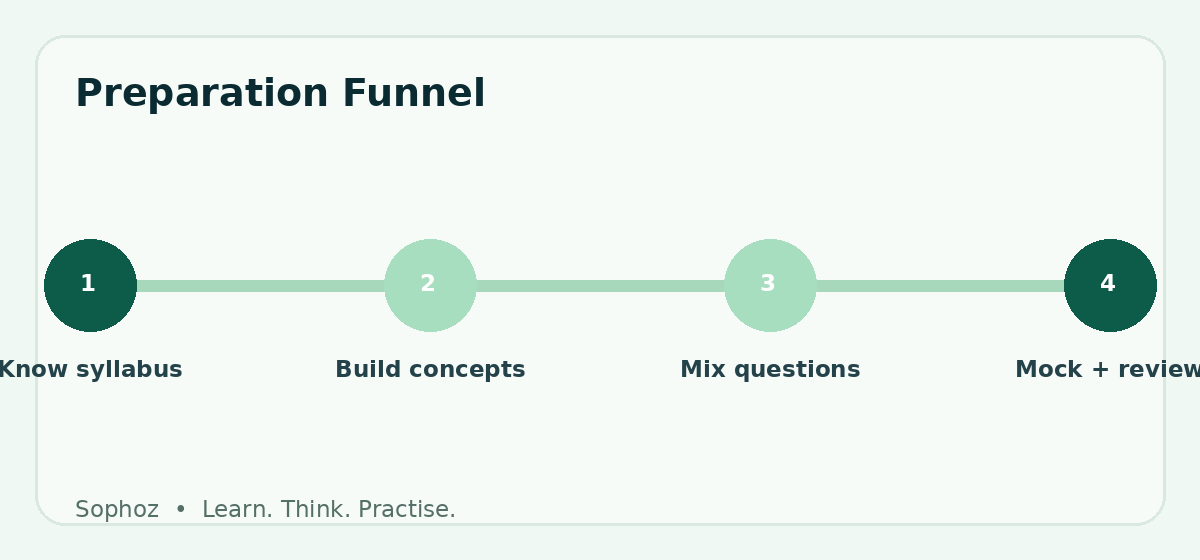
Start with a diagnostic. Repair genuine concept gaps. Practise each major question family. Mix topics so the method is not obvious. Introduce timed sections. Finish with mock papers, error review and a lighter final week.
The objective is not to predict every question. It is to give the learner enough conceptual strength and problem-solving flexibility to handle questions they have not seen before.
A practical way to use this guidance at home
Choose one small change rather than rebuilding the entire routine in a day. For example, introduce a five-minute retrieval warm-up, begin an error log, or replace one chapter-labelled worksheet with a mixed set. Use the change consistently for two weeks and observe what happens.
Parents should look for behavioural evidence as well as scores. Does the learner begin work with less prompting? Do they explain ideas more clearly? Are the same mistakes recurring less often? Can they identify what they find difficult? These indicators help distinguish productive practice from mere activity.
Keep the environment simple. A clear desk, the required materials, a visible timer when timing is appropriate and a defined end point can reduce negotiation. Finish while the learner still has some energy rather than extending every session until attention disappears.
Questions parents can ask after practice
Useful questions keep the focus on learning: Which question required the most thinking? What clue helped you? Where did your first approach fail? Which mistake would you recognise faster next time? Can you explain one solution without looking at your notes?
Avoid turning reflection into interrogation. One or two questions are enough. The aim is to help the child notice their own thinking so that strategies gradually become self-directed.
Over time, invite the learner to choose part of the next session. They might select a weak topic to revisit or a problem they want to retry. Small choices can increase ownership without removing structure.
What success should mean
A competition naturally produces scores and ranks, but preparation can be judged more broadly. A successful learner becomes more accurate, more strategic and more willing to engage with unfamiliar material. They recover from errors faster and need fewer external prompts.
Those capabilities are valuable even when a particular paper is unusually difficult. They also reduce the temptation to treat one result as a permanent label.
Use the exam as a checkpoint. After it, discuss what worked, what the learner would change and which kinds of problems they would still enjoy exploring. That turns a one-day event into useful information for future learning.
A final note for families
Preparation works best when it remains proportionate to the child's age and wider life. The purpose of structured practice is to make thinking clearer, not to fill every free hour. Keep expectations explicit, feedback specific and the routine predictable.
When a learner struggles, diagnose before increasing pressure. When a learner succeeds, ask what strategy contributed. In both cases, direct attention toward processes that can be repeated. That is how an exam-specific routine can contribute to a more general ability to learn independently.
Revisit the plan regularly. What was appropriate four weeks ago may no longer be the best use of time today. Strong learning plans are responsive: they preserve what is working, remove what is not and keep the next challenge within reach.
Sources and further reading
- SOF IMO Class 6 syllabus and pattern
- SOF IMO 2026–27 overview
- SOF Class 6 IMO preparation guide
- SOF Class 6 Science syllabus
- Education Endowment Foundation: cognitive science in practice
Exam details can change. Always verify the current syllabus, dates and pattern with the official organiser.