
How to Improve Problem-Solving Skills in Children
By The Sophoz Curriculum Team
The goal is not more worksheets. It is stronger understanding, better decisions and more independent problem solving.
Problem solving can be taught
Children are sometimes described as 'natural problem solvers' or 'not problem-solving types'. That framing is too fixed. While learners differ, many of the behaviours that support problem solving can be practised directly.
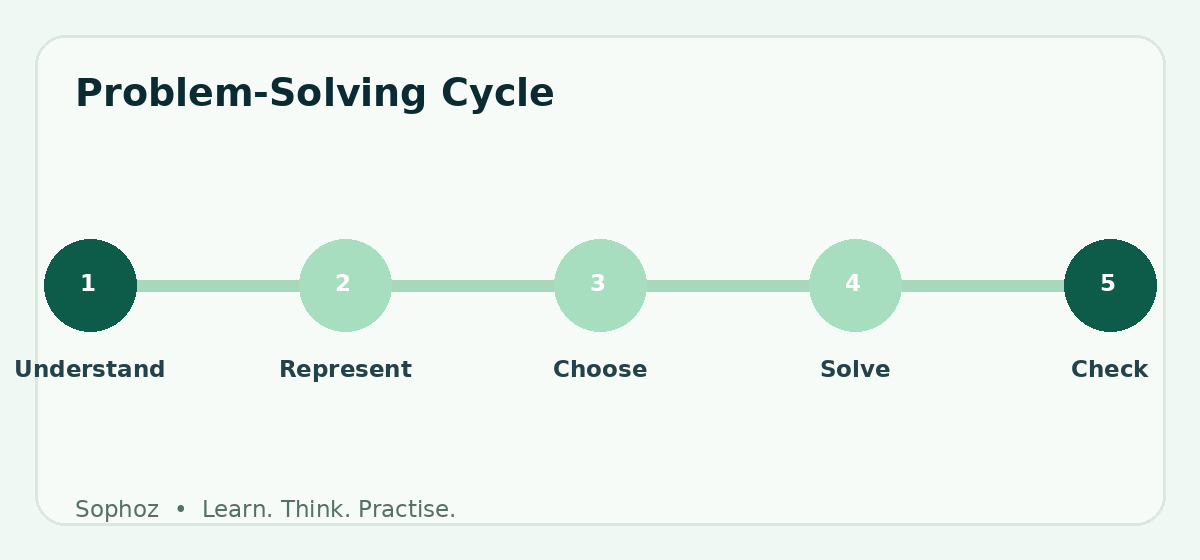
A strong problem solver reads carefully, represents information, connects the problem with prior knowledge, tries a strategy, monitors whether it is working and changes course when needed. Each of those behaviours can become more deliberate.
Ask before you tell
When a child gets stuck, adults often rescue them quickly. The intention is kind, but repeated rescue can teach the learner that difficulty is the signal to wait for instructions.
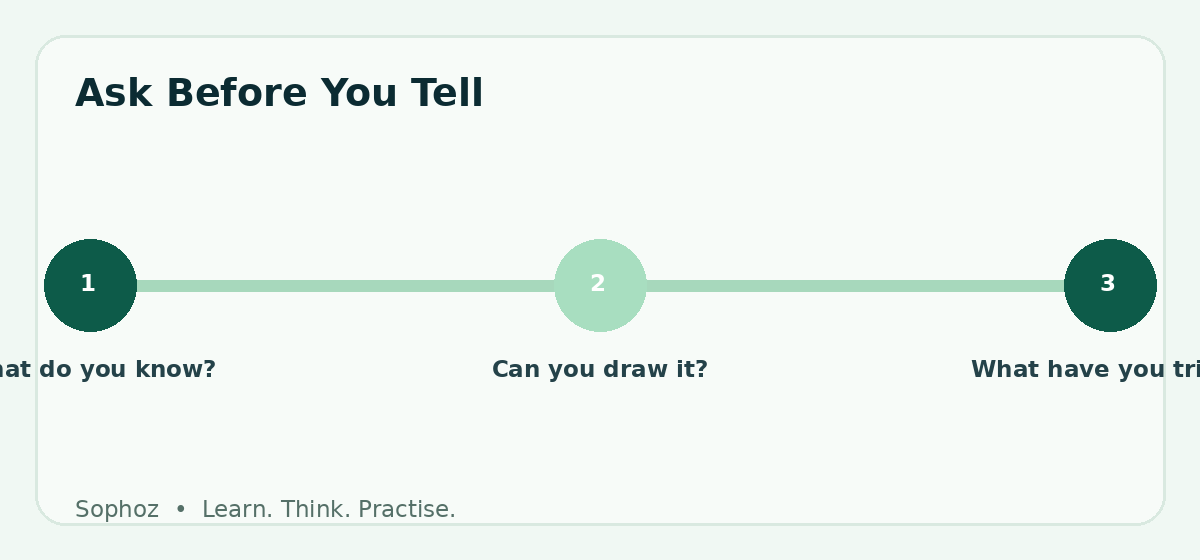
Try a sequence of prompts instead: What is the question asking? What information do you have? What have you tried? Can you draw it? Is there a smaller version? Which part do you understand? Give the smallest hint that allows thinking to restart.
Teach representation
A problem written in words does not have to remain in words. Encourage tables, sketches, number lines, bar models, lists, diagrams and physical objects.
Representation reduces the amount of information that must be held mentally and can expose relationships. Over time, children learn to choose representations themselves.
Use estimation as a checking tool
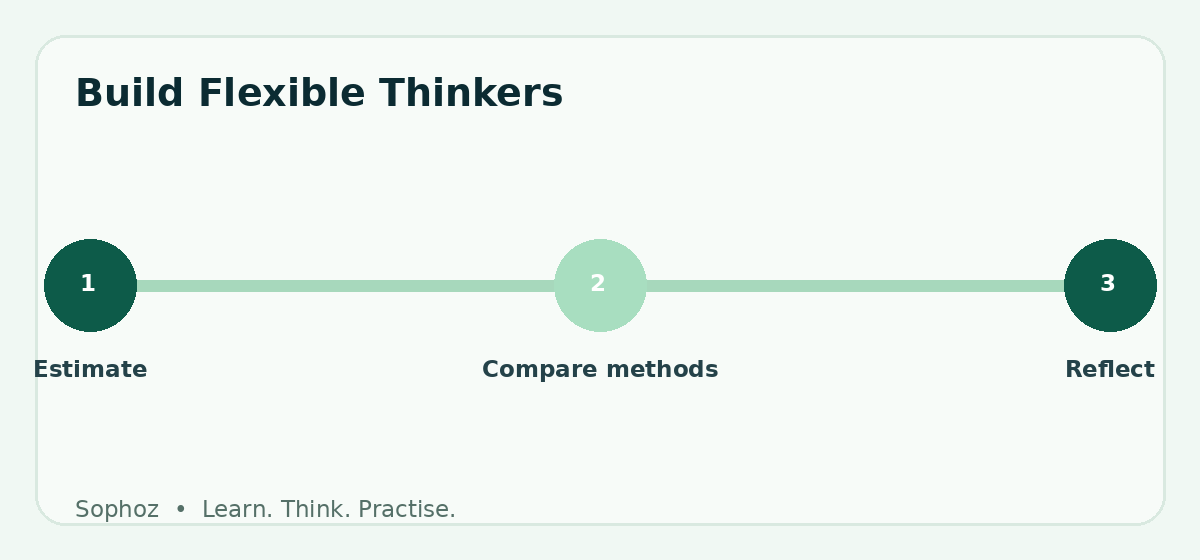
Before exact calculation, ask for a rough range. Should the answer be closer to 10, 100 or 1,000? Should a fraction be greater or less than one? Is the distance likely to be larger or smaller than the original?
Estimation builds number sense and gives the learner an internal alarm when an exact answer is implausible.
Compare methods
After a correct solution, resist the urge to move immediately to the next question. Ask whether there is another way. Which method is easier to explain? Which is faster? Which would work if the numbers changed?
Comparing methods develops flexibility and helps learners see mathematics as connected ideas rather than isolated procedures.
Use worked examples strategically
For a genuinely new problem type, a worked example can prevent unnecessary confusion. But do not leave the learner as a spectator. Ask them to explain each step, predict the next step or complete a partially worked example.
Then remove the support. Independence should increase across the sequence.
Build an error culture
Children need to experience errors as information. That does not mean celebrating careless work; it means separating the mistake from the learner's identity.
Ask: Where did the solution first go off track? What clue did we miss? What would you do differently next time? Retry a similar problem later so the correction becomes usable.
Choose the right level of challenge
A useful problem sits beyond immediate recall but within reach of the learner's current knowledge. If every question requires an adult to take over, reduce complexity. If every question is automatic, add novelty or require explanation.
Challenge should create thinking, not helplessness.
Make reflection routine
At the end of a session, use three questions: Which problem made you think the most? Where did you get stuck? What strategy will you remember next time?
Reflection helps children turn an isolated experience into a reusable method.
Problem solving outside worksheets
Puzzles, cooking measurements, route planning, games, building projects and everyday estimation can all create reasoning opportunities. The point is not to turn family life into constant tuition. It is to let children see that problem solving is a way of interacting with the world.
A practical way to use this guidance at home
Choose one small change rather than rebuilding the entire routine in a day. For example, introduce a five-minute retrieval warm-up, begin an error log, or replace one chapter-labelled worksheet with a mixed set. Use the change consistently for two weeks and observe what happens.
Parents should look for behavioural evidence as well as scores. Does the learner begin work with less prompting? Do they explain ideas more clearly? Are the same mistakes recurring less often? Can they identify what they find difficult? These indicators help distinguish productive practice from mere activity.
Keep the environment simple. A clear desk, the required materials, a visible timer when timing is appropriate and a defined end point can reduce negotiation. Finish while the learner still has some energy rather than extending every session until attention disappears.
Questions parents can ask after practice
Useful questions keep the focus on learning: Which question required the most thinking? What clue helped you? Where did your first approach fail? Which mistake would you recognise faster next time? Can you explain one solution without looking at your notes?
Avoid turning reflection into interrogation. One or two questions are enough. The aim is to help the child notice their own thinking so that strategies gradually become self-directed.
Over time, invite the learner to choose part of the next session. They might select a weak topic to revisit or a problem they want to retry. Small choices can increase ownership without removing structure.
What success should mean
A competition naturally produces scores and ranks, but preparation can be judged more broadly. A successful learner becomes more accurate, more strategic and more willing to engage with unfamiliar material. They recover from errors faster and need fewer external prompts.
Those capabilities are valuable even when a particular paper is unusually difficult. They also reduce the temptation to treat one result as a permanent label.
Use the exam as a checkpoint. After it, discuss what worked, what the learner would change and which kinds of problems they would still enjoy exploring. That turns a one-day event into useful information for future learning.
A final note for families
Preparation works best when it remains proportionate to the child's age and wider life. The purpose of structured practice is to make thinking clearer, not to fill every free hour. Keep expectations explicit, feedback specific and the routine predictable.
When a learner struggles, diagnose before increasing pressure. When a learner succeeds, ask what strategy contributed. In both cases, direct attention toward processes that can be repeated. That is how an exam-specific routine can contribute to a more general ability to learn independently.
Revisit the plan regularly. What was appropriate four weeks ago may no longer be the best use of time today. Strong learning plans are responsive: they preserve what is working, remove what is not and keep the next challenge within reach.
Sources and further reading
- SOF IMO Class 6 syllabus and pattern
- SOF IMO 2026–27 overview
- SOF Class 6 IMO preparation guide
- SOF Class 6 Science syllabus
- Education Endowment Foundation: cognitive science in practice
Exam details can change. Always verify the current syllabus, dates and pattern with the official organiser.