
10 Most Asked Questions by Parents About Olympiads
By The Sophoz Curriculum Team
The goal is not more worksheets. It is stronger understanding, better decisions and more independent problem solving.
1. What does an Olympiad actually test?
Most school Olympiads are designed to test more than direct recall. They typically ask learners to apply age-appropriate knowledge through reasoning, patterns, unfamiliar contexts and multi-step decisions. That is why a child may know a chapter well and still need time to become comfortable with Olympiad-style questions.
The useful preparation response is not to race ahead through future-grade content. First make current foundations secure, then expose the learner to varied problems in which the method is not announced in advance.
2. Is Olympiad maths harder than school maths?
It can feel harder, but 'different' is often the better description. A school exercise may follow immediately after an example of the same type. An Olympiad question may combine two ideas, hide useful information in a diagram or include a condition that changes the obvious answer.
This means strong school performance is helpful but not sufficient evidence that a child will immediately be fluent in Olympiad questions. The missing skill may simply be familiarity with non-routine problem solving.
3. When should my child start preparing?
For many school-level exams, an eight-to-twelve-week focused preparation period is a sensible starting point. A child who enjoys enrichment can certainly solve interesting problems throughout the year, but preparation does not need to become a permanent high-pressure programme.
Starting earlier is useful only when the extra time is used well: spaced review, varied questions and reflection. Repeating the same workbook for months does not automatically create deeper reasoning.
4. How much time should my child spend each week?
For many Class 6 learners, three or four sessions of about 30–40 focused minutes can be enough to create continuity. Younger learners may need shorter sessions; experienced competitors may choose more. The correct workload is the one that produces learning without damaging sleep, school responsibilities or motivation.
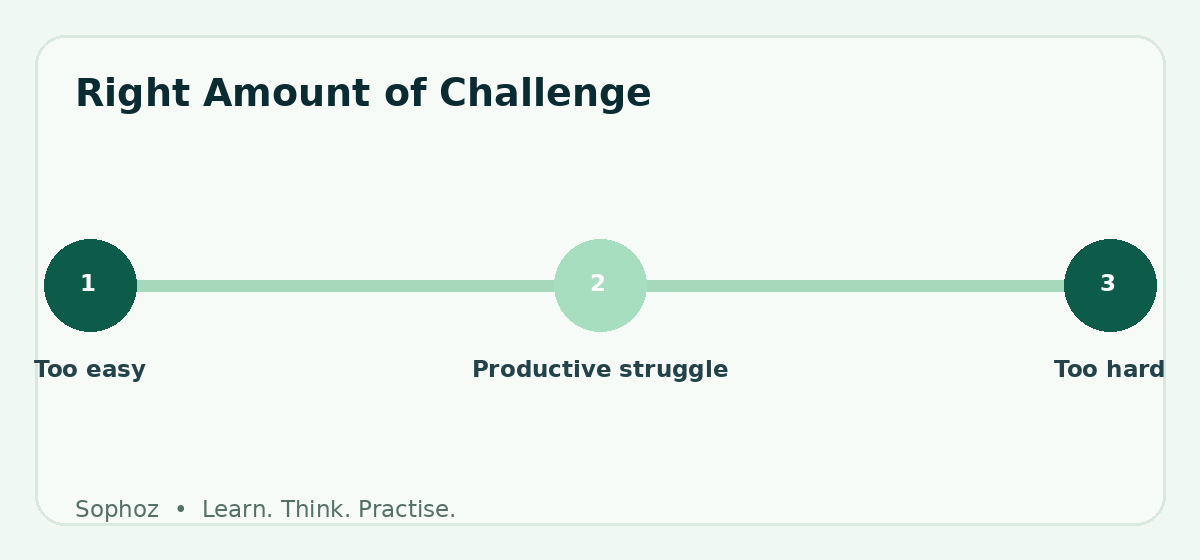
Look at the quality of attention. If the learner is making increasingly careless mistakes or resisting every session, adding time is unlikely to help. If every question is effortless and no unfamiliar problems appear, increase challenge before increasing duration.
5. My child knows the maths but still gets Olympiad questions wrong. Why?
Separate knowledge from execution. The child may be missing a condition, misinterpreting a diagram, selecting the first familiar method, doing too much mental arithmetic or failing to check whether an answer is plausible.
Keep an error log for two or three weeks. Label mistakes by cause rather than chapter. This often reveals a small number of recurring habits that can be improved directly.
6. Should we buy several question banks?
More resources can create the illusion of a stronger plan. In practice, one well-chosen core resource, a source of varied questions and later a set of mock papers may be enough. What matters is what the learner does with each question.
After a difficult problem, discuss the key idea, try a related problem after a gap and occasionally compare two solution methods. That depth is often more valuable than racing through another hundred items.
7. How do I know whether my child is ready?
Readiness is multidimensional. Look for secure school-level concepts, willingness to attempt unfamiliar questions, the ability to explain a method, improving accuracy on mixed sets and increasingly sensible pacing.
A mock paper can help, but a single score is noisy. Use several pieces of evidence. If a child can identify why they made an error and correct it on a later attempt, that is meaningful progress.
8. What if preparation is making my child anxious?
Reduce the stakes immediately. Shorten sessions, include solvable warm-ups and stop using rank as the main measure of success. Difficult questions should feel like puzzles to investigate, not proof of ability or inability.
If anxiety persists or begins affecting sleep, school or wellbeing, the exam is not more important than the child. Stepping back, strengthening foundations and returning to challenge later is a reasonable choice.
9. Are shortcuts and tricks useful?
Yes, after understanding. A shortcut can improve efficiency when the learner knows why it works and when it applies. A memorised trick without a mental model is fragile: small changes in the question can make it useless.
Ask the child to explain the shortcut in ordinary language or demonstrate it on a simple example. If they cannot, return to the underlying idea.
10. What is the parent's best role?
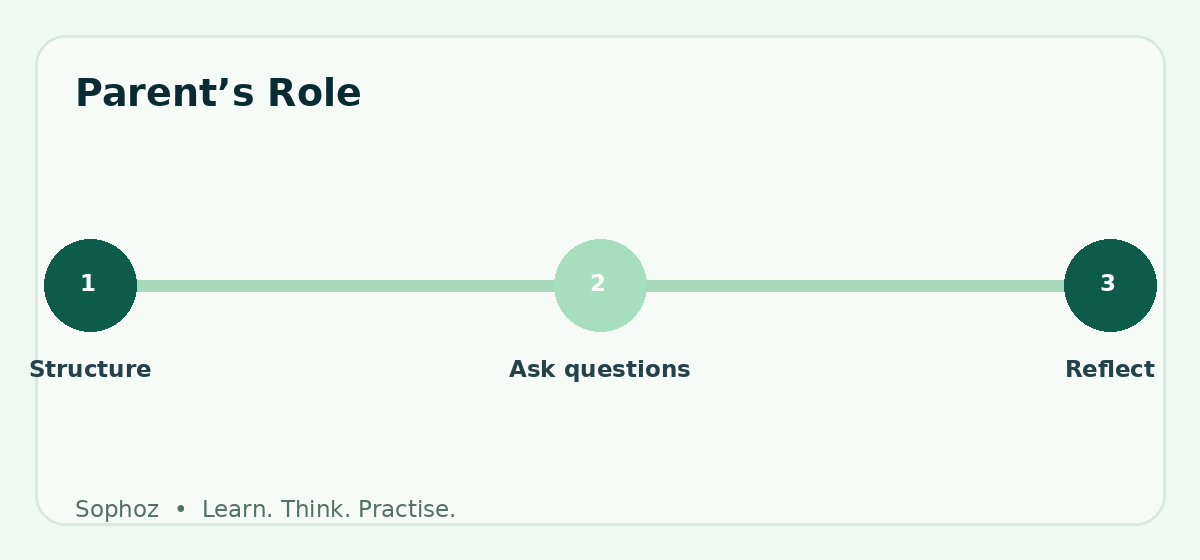
Be the architect of the routine rather than the solver of every question. Help schedule practice, provide suitable resources, protect sleep and encourage reflection. When the child is stuck, ask questions before giving instructions.
The long-term win is not a parent who can push a child through a worksheet. It is a learner who gradually knows what to do when nobody is sitting beside them.
What progress should look like
Progress is often visible before it appears dramatically in scores. The learner reads more carefully, draws useful representations without being told, abandons an unproductive approach sooner, checks answers more naturally and can describe recurring mistakes.
Those behaviours are worth noticing. They are signs that preparation is building capability rather than simply rehearsing for one exam.
A practical way to use this guidance at home
Choose one small change rather than rebuilding the entire routine in a day. For example, introduce a five-minute retrieval warm-up, begin an error log, or replace one chapter-labelled worksheet with a mixed set. Use the change consistently for two weeks and observe what happens.
Parents should look for behavioural evidence as well as scores. Does the learner begin work with less prompting? Do they explain ideas more clearly? Are the same mistakes recurring less often? Can they identify what they find difficult? These indicators help distinguish productive practice from mere activity.
Keep the environment simple. A clear desk, the required materials, a visible timer when timing is appropriate and a defined end point can reduce negotiation. Finish while the learner still has some energy rather than extending every session until attention disappears.
Questions parents can ask after practice
Useful questions keep the focus on learning: Which question required the most thinking? What clue helped you? Where did your first approach fail? Which mistake would you recognise faster next time? Can you explain one solution without looking at your notes?
Avoid turning reflection into interrogation. One or two questions are enough. The aim is to help the child notice their own thinking so that strategies gradually become self-directed.
Over time, invite the learner to choose part of the next session. They might select a weak topic to revisit or a problem they want to retry. Small choices can increase ownership without removing structure.
What success should mean
A competition naturally produces scores and ranks, but preparation can be judged more broadly. A successful learner becomes more accurate, more strategic and more willing to engage with unfamiliar material. They recover from errors faster and need fewer external prompts.
Those capabilities are valuable even when a particular paper is unusually difficult. They also reduce the temptation to treat one result as a permanent label.
Use the exam as a checkpoint. After it, discuss what worked, what the learner would change and which kinds of problems they would still enjoy exploring. That turns a one-day event into useful information for future learning.
A final note for families
Preparation works best when it remains proportionate to the child's age and wider life. The purpose of structured practice is to make thinking clearer, not to fill every free hour. Keep expectations explicit, feedback specific and the routine predictable.
When a learner struggles, diagnose before increasing pressure. When a learner succeeds, ask what strategy contributed. In both cases, direct attention toward processes that can be repeated. That is how an exam-specific routine can contribute to a more general ability to learn independently.
Revisit the plan regularly. What was appropriate four weeks ago may no longer be the best use of time today. Strong learning plans are responsive: they preserve what is working, remove what is not and keep the next challenge within reach.
Sources and further reading
- SOF IMO Class 6 syllabus and pattern
- SOF IMO 2026–27 overview
- SOF Class 6 IMO preparation guide
- SOF Class 6 Science syllabus
- Education Endowment Foundation: cognitive science in practice
Exam details can change. Always verify the current syllabus, dates and pattern with the official organiser.