
Science Olympiad Preparation Tips
By The Sophoz Curriculum Team
The goal is not more worksheets. It is stronger understanding, better decisions and more independent problem solving.
Begin with the current exam, not a generic science list
Science Olympiads differ by organiser and class. Before planning, confirm the current official syllabus, pattern and dates for the exact exam. For SOF's current Class 6 International Science Olympiad page, the published syllabus includes verbal and non-verbal reasoning plus science topics spanning food, materials, water, separation, living-world diversity, magnets, measurement and motion, temperature, space and natural resources.
That breadth means preparation should be organised rather than reactive. Make a topic map and identify which areas are secure, developing and weak.
Understand before memorising
Science includes facts, but disconnected memorisation is fragile. Link facts to mechanisms and models. If a learner knows that something happens, ask why. What evidence would show it? What changes if one condition changes? What would you predict in a related situation?
This makes knowledge more usable when a question is phrased differently from the textbook.
Use diagrams actively
Diagrams are not decorations. Ask the learner to label a diagram from memory, redraw a simplified version, compare two diagrams and predict what changes if one component is removed.
When reviewing an incorrect diagram question, identify whether the problem was missing knowledge or weak interpretation. Those require different practice.
Practise observation and inference
Science questions often present an observation and ask for the best conclusion. Teach the distinction between what is directly shown and what is inferred.
A useful habit is to ask: What does the information definitely tell us? What is possible but not proven? Which option requires an assumption that the question did not provide?
Bring experiments into the reasoning
Even when preparation is paper-based, think experimentally. Ask what variable changes, what should be controlled, what measurement would be useful and what result would support a claim.
This turns science from a list of statements into a way of investigating questions.
Mix topics after foundations are secure
Chapter-by-chapter practice is useful early. Later, mix topics so the learner must identify which concept applies. Include data tables, diagrams, classification, cause-and-effect and everyday contexts.
Mixed practice is especially useful because a real paper does not announce the chapter before each question.
Use retrieval and spacing
At the start of a session, ask a few questions from older topics without notes. Bring important concepts back after several days and again after a longer gap.
Retrieval should be low stakes. The purpose is to strengthen access and expose forgetting early enough to fix it.
Mock tests are diagnostic
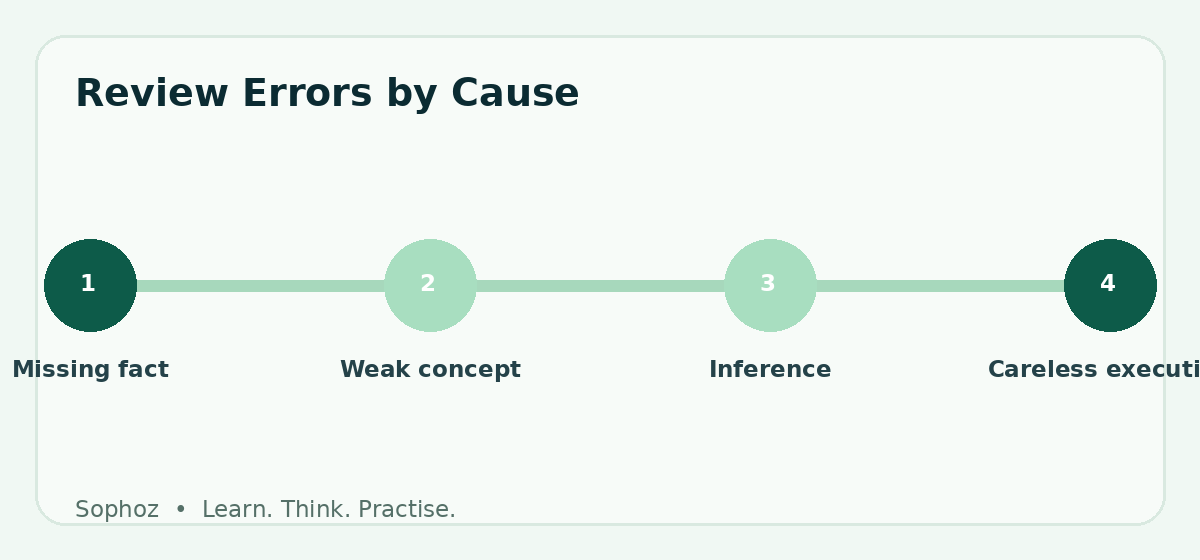
Use current-pattern mock papers later in preparation. After each one, classify errors as missing fact, weak concept, diagram interpretation, faulty inference, careless execution or pacing.
The category tells you what to practise next. Simply doing another full paper may reproduce the same mistakes.
The final week
Review key models, common diagrams, recurring errors and representative reasoning questions. Reduce volume and protect sleep.
Science Olympiad preparation works best when the learner enters the paper ready to think, not overloaded with last-minute facts.
A practical way to use this guidance at home
Choose one small change rather than rebuilding the entire routine in a day. For example, introduce a five-minute retrieval warm-up, begin an error log, or replace one chapter-labelled worksheet with a mixed set. Use the change consistently for two weeks and observe what happens.
Parents should look for behavioural evidence as well as scores. Does the learner begin work with less prompting? Do they explain ideas more clearly? Are the same mistakes recurring less often? Can they identify what they find difficult? These indicators help distinguish productive practice from mere activity.
Keep the environment simple. A clear desk, the required materials, a visible timer when timing is appropriate and a defined end point can reduce negotiation. Finish while the learner still has some energy rather than extending every session until attention disappears.
Questions parents can ask after practice
Useful questions keep the focus on learning: Which question required the most thinking? What clue helped you? Where did your first approach fail? Which mistake would you recognise faster next time? Can you explain one solution without looking at your notes?
Avoid turning reflection into interrogation. One or two questions are enough. The aim is to help the child notice their own thinking so that strategies gradually become self-directed.
Over time, invite the learner to choose part of the next session. They might select a weak topic to revisit or a problem they want to retry. Small choices can increase ownership without removing structure.
What success should mean
A competition naturally produces scores and ranks, but preparation can be judged more broadly. A successful learner becomes more accurate, more strategic and more willing to engage with unfamiliar material. They recover from errors faster and need fewer external prompts.
Those capabilities are valuable even when a particular paper is unusually difficult. They also reduce the temptation to treat one result as a permanent label.
Use the exam as a checkpoint. After it, discuss what worked, what the learner would change and which kinds of problems they would still enjoy exploring. That turns a one-day event into useful information for future learning.
A final note for families
Preparation works best when it remains proportionate to the child's age and wider life. The purpose of structured practice is to make thinking clearer, not to fill every free hour. Keep expectations explicit, feedback specific and the routine predictable.
When a learner struggles, diagnose before increasing pressure. When a learner succeeds, ask what strategy contributed. In both cases, direct attention toward processes that can be repeated. That is how an exam-specific routine can contribute to a more general ability to learn independently.
Revisit the plan regularly. What was appropriate four weeks ago may no longer be the best use of time today. Strong learning plans are responsive: they preserve what is working, remove what is not and keep the next challenge within reach.
Sources and further reading
- SOF IMO Class 6 syllabus and pattern
- SOF IMO 2026–27 overview
- SOF Class 6 IMO preparation guide
- SOF Class 6 Science syllabus
- Education Endowment Foundation: cognitive science in practice
Exam details can change. Always verify the current syllabus, dates and pattern with the official organiser.